By Rohan Gunaratna
Introduction
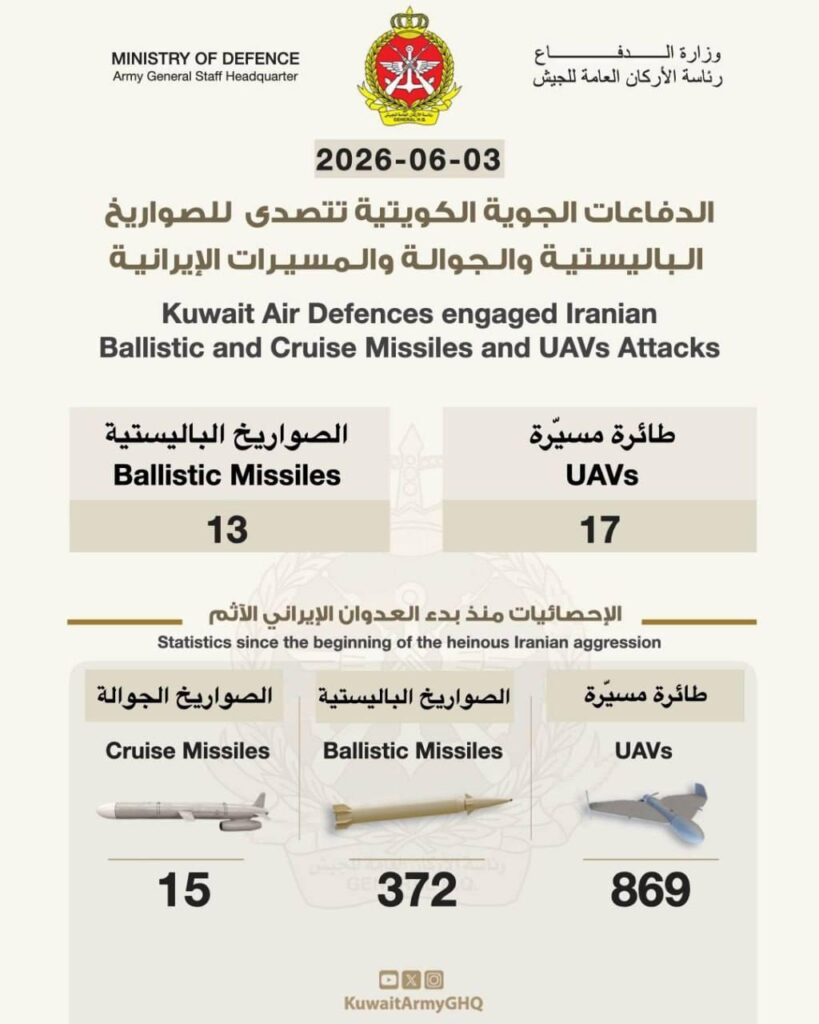
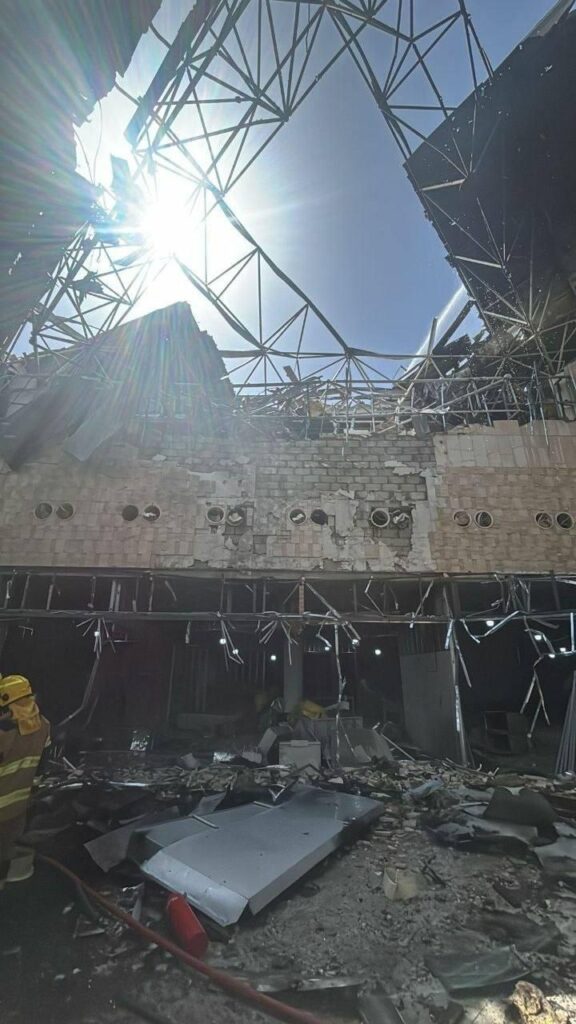
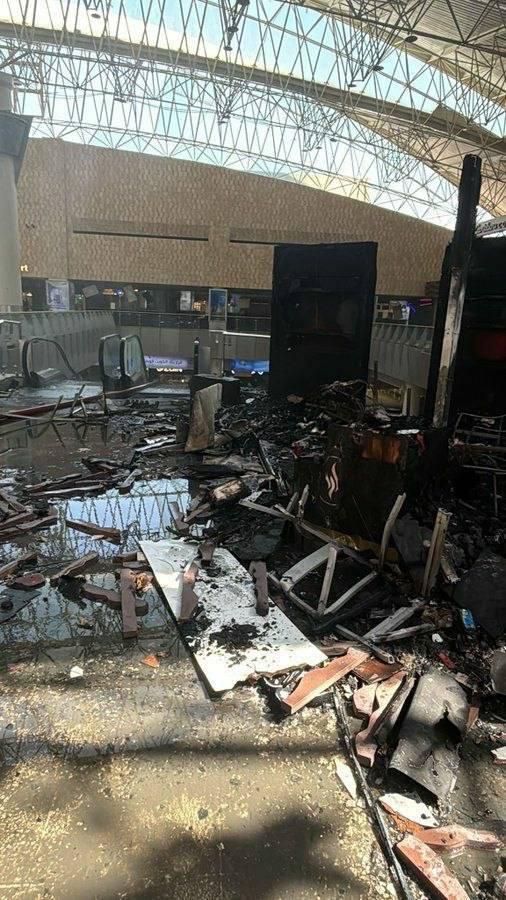
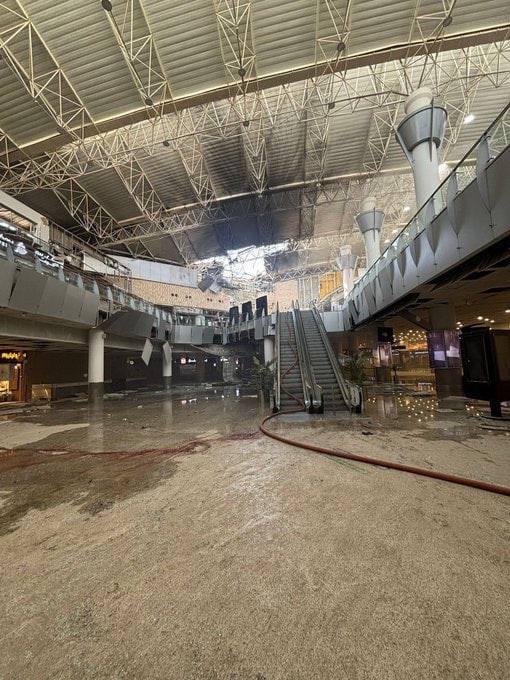
In the early hours of June 3, 2026, Iran attacked Kuwait and Bahrain in response to a U.S. attack on Iran. Although the Iranian aerospace weapons targeting the US Fifth Fleet in Bahrain was intercepted, the Iranian missiles and drones hit the Kuwait International Airport killing one Indian national, injuring 63 other people, and causing significant structural damage to terminal 1. The incident forced civil aviation authorities to temporarily suspend flights and divert air traffic. The strike was part of an escalating regional conflict between Iran and US forces in the Gulf and broke a ceasefire that had been in place since April 8, 2026[1].
Iran struck in response to a U.S. attack on a key military communications facility and telecommunications tower located on Qeshm Island in the Strait of Hormuz. The U.S. military conducted self-defence strikes on Iranian radar installations and command-and-control stations for drones near the southern coastal city of Goruk and on Qeshm Island. U.S. fighter jets actively targeted and disabled the Iranian military’s air defence assets and ground control networks. The U.S. also attacked directly hitting and damaging the engine room of an Iranian oil tanker transiting near the strategically sensitive Strait of Hormuz. The tit for tat attacks started after Iran shot down an American MQ-1 drone on May 30, 2026. In addition, Iran attempted several drone strikes against civilian shipping vessels.
The U.S. Central Command announced that it disabled an oil tanker attempting to break the blockade in the Strait of Hormuz and reach Kharg Island. According to CENTCOM, an American missile struck the vessel’s engine room after it failed to respond to orders to stop for nearly a day.
Air defense systems were activated in Kuwait following missile and drone launches. Later, sirens were also heard in Bahrain.
A missile strike by US forces on the Botswana-flagged M/T Lexie, an unladen oil tanker attempting to sail to an Iranian port in violation of an American blockade, disabled the vessel.
In retaliation, IRGC attacked Bahrain and Kuwait. Bahrain’s air defenses successfully intercepted three missiles and several drones fired by Iran. Iran’s Islamic Revolutionary Guard Corps (IRGC) said it launched a swarm of drones and missiles that struck the US Navy’s Fifth Fleet headquarters, based in Bahrain, in response to what it said was a US attack on Qeshm Island[2].
“These responses should serve as a lesson,” the IRGC added in a statement.
However, the US Central Command (CENTCOM) said the Iranian attacks on US bases and forces in Bahrain failed. However, IRGC aerospace weapons successfully struck the international airport in Kuwait.
The IRGC claimed that the United States attacked an Iranian oil tanker near the Strait of Hormuz using aerial munitions. In response, they said their navy attacked the Panaya vessel.
The IRGC also claimed that, in response to an attack on one of their communications towers in southern Qeshm Island, they launched missiles and drones against a U.S. military base in one of the Gulf countries, as well as against the headquarters of the U.S. Fifth Fleet.
“We have already warned that in the event of aggression, our response would be different and more severe, and so we acted accordingly. These responses were intended to serve as a lesson. Any threat to the security of the Strait of Hormuz will exact a heavy price from the attacking U.S. military.”
CENTCOM stated that American forces successfully intercepted several Iranian ballistic missiles and drones. It also reported carrying out self-defense strikes on Qeshm Island in response to Iranian attack attempts, including a strike against an Iranian ground military command facility.
According to CENTCOM, two Iranian missiles launched toward Kuwait either fell short or disintegrated in flight, while three missiles fired toward Bahrain were immediately intercepted by U.S. and Bahraini air defense systems.
The spokesman for Kuwait’s Ministry of Defense announced this morning that an Iranian drone attack caused significant damage to the terminal building at Kuwait International Airport and resulted in several injuries.
Kuwait’s Civil Aviation Authority announced that flights at the airport have been suspended and diverted to alternate airports until safety procedures are completed and the airport is cleared to resume operations.
Technical teams have begun inspecting and assessing the damage to facilities and operational systems in preparation for repair and restoration.
The Iranian supreme leader’s military adviser, Mohsen Rezaei, said: “Every shot fired and every attack will be met with a deluge of missiles and drones … the aggressor will swiftly be punished”.
Oman attacked too
Iran’s navy said on Friday, 5th June, 2026, it had fired warning missiles and drones at U.S. warships in the Gulf of Oman, accusing the U.S. Navy of harassing maritime traffic and seizing commercial vessels and oil tankers, Iranian state media reported.
Earlier, the U.S. Indo-Pacific Command said U.S. forces had intercepted the sanctioned stateless vessel M/T DAVINA in the Indian Ocean overnight[3].
An explosion struck near the facility’s single-buoy mooring (SBM) berths. The incident happened amid continuing conflict in the region with stalled US-Iran peace talks dragging on, and shipping traffic through the Strait of Hormuz severely restricted.
The blast occurred between the SBM 1 and SBM 2 berths.Several supertankers were seen anchored off Mina al Fahal on Friday, according to shipping data from LSEG cited by Reuters. The port, located on Oman’s north-eastern coast near the capital Muscat, is the country’s main crude oil export terminal[4].
Iran’s strategy
Overnight, Iran fired at least 10 ballistic missiles toward Kuwait. This is the largest Iranian attack on a Gulf state since last month’s missile fire toward the United Arab Emirates.
Iran’s doctrine of attacking Gulf states in retaliation for foreign aggression is based on “triangular coercion” and “cost imposition”.
Triangular coercion is a three-party indirect strategy. When a weaker coercer cannot influence or outmatch a resilient, powerful adversary directly, it coerces or inflicts costs on a mutually vulnerable third party that has leverage over the ultimate target. Iran lacks direct leverage over the US. So, instead, Iran attacks or threatens the Gulf countries. By threatening or exposing the vulnerabilities of the Gulf countries, Iran successfully forces the Gulf countries to act on its behalf[5].
Cost imposition is an economic and operational strategy designed to inflict a disproportionate amount of financial, material, or logistical pain on an adversary. It forces the enemy to spend exorbitant amounts of money, time, and resources to counter relatively inexpensive attacks. So, instead of fighting force-on-force, a weaker actor uses low-cost asymmetric weapons (e.g., cheap drones or localised blockades) to threaten highly valuable targets or infrastructure. In the end the stronger adversary is forced to deploy incredibly expensive counter-measures just to neutralise a cheap threat. Over time, this creates a strategy of financial attrition, resulting in massive second-order impacts. The goal is to cause severe economic and political exhaustion, compelling the stronger state to reevaluate its war aims and withdraw[6].
As Tehran cannot match the conventional military power of the U.S. or Israel, its strategy is to use asymmetric tactics to raise the political, economic, and logistical costs of ongoing conflicts. Core tenets of this doctrine is Iran holding Gulf states responsible for attacks if they allow the U.S. or allied powers to use their territory, airspace, or military bases to launch those attacks. Also known as ‘deterrence by punishment’, Tehran targets critical civilian and economic infrastructure across the Gulf Cooperation Council (GCC) states. By striking hubs, airports, and oil/gas facilities, Iran’s IRGC aims to leverage regional prosperity to force Gulf governments to pressure Washington to limit military operations.
Iran asserts control over the narrow waterway, Strait of Hormuz, using its geography to threaten global oil transit and cause immediate economic shockwaves. Instead of decisive military victories, Iran focuses on enduring a prolonged war of attrition. Its “mosaic defense” doctrine distributes military and missiIe resources to give provincial commanders independent retaliation capabilities. This strategy inherently risks hardening hostilities and pushing neutral Gulf nations further into the U.S.-Israeli camp.
—
Rohan Gunaratna is a professor of Security Studies at the S. Rajaratnam School of International Studies at the Nanyang Technological University. He is a trainer for law enforcement, national security and military counter terrorism units; and is the author and editor of over 30 books.
[1] https://www.bbc.com/news/videos/c1j2640ln88o
[2] https://www.abc.net.au/news/2026-06-03/us-and-iran-launch-strikes-qeshm-island/106752864
[3] https://www.reuters.com/world/middle-east/iran-says-it-fired-warning-missiles-drones-us-warships-gulf-oman-2026-06-05/
[4] https://www.newarab.com/news/what-we-know-about-reported-explosion-omans-oil-terminal
[5] https://www.nytimes.com/2026/05/20/world/middleeast/iran-strait-of-hormuz-triangular-coercion.html
[6] https://mwi.westpoint.edu/cost-imposition-the-key-to-making-great-power-competition-an-actionable-strategy/
Платформы для совершеннолетних способны служить способом интимного образования, а также поддержкой в понимании личных желаний.
Подобные сервисы дают возможность людям изучать собственные границы в безопасной среде, уменьшая риски фактических последствий.
ero-storitop.com
Для пар совместное ознакомление таких сюжетов может укреплять взаимопонимание и становиться стимулом для откровенного диалога о желаниях и границах.
Кроме того такие ресурсы предоставляют возможность для осторожной реализации напряжения и уменьшения стресса, не причиняя вреда окружающим.
Продвижение веб-ресурсов — это система усилий, нацеленных на улучшение рейтинга в поисковой выдаче.
Главная миссия поисковой оптимизации — поднять проект на первые места поисковой выдачи по нужным фразам.
http://prodvizhenie-saytov-moskva.ru/prodvizhenie-saytov-v-rostove-na-donu/
Чтобы достичь такого результата эксперты выполняют внутренний аудит, работают над контентом, структурой и ссылками.
В итоге сайт делается популярнее в поиске, собирает больше аудитории и увеличивает конверсию.