By Rohan Gunaratna
Introduction
The Hamas announced on July 6, 2026 that it is relinquishing its rule of the Gaza Strip. Is Hamas doing this to preserve its political survival and military capabilities? There is consensus after the Hamas led October 7 2023 massacre that Hamas should play no role in governing the Gaza Strip. The exception is the Iranian regime and its partners and proxies that continues to support Hamas and other threat groups in Gaza.
Like most political movements, Hamas is cunning. Hamas seeks to preserve the organisation and its ideology that has brought untold suffering to the Palestinians and Israelis. Hamas dissolved its de facto government in Gaza to facilitate a transition of power to a U.S.-backed, technocratic committee. Although Hamas is stepping back from day-to-day administration, will Hamas control the technocratic committee?
Hamas officials have publicly stated that relinquishing civilian control is intended to remove justifications for Israel to continue its military operations and occupation in the territory. The dissolution aligns with the U.S.-brokered ceasefire plan. This framework—overseen by the Board of Peace established during the October 2025 truce—requires Hamas to hand over civilian administrative duties to the National Committee for the Administration of Gaza (NCAG). United States-backed NCAG explicitly excludes Hamas. However, Hamas has actively sought to incorporate its civil servants and thousands of security personnel into the new body, prompting strict demands from international mediators for rigorous vetting to prevent infiltration. By allowing technocrats to manage the devastated enclave’s civil administration, reconstruction, and basic services, Hamas hopes to separate the burden of governance from its military faction. This allows Hamas to avoid being blamed for the collapse of civil infrastructure while retaining control over security and policing in its remaining strongholds. As Hamas will shadow the developments in Gaza and seek to influence it, the practical implementation of this shift remains to be seen.
There is consensus that Hamas should disarm and demobilise. The negotiations have stalled regarding Hamas’s disarmament and demobilisation. Aware of the true intentions of Hamas, Israeli objects to the NCAG from physically entering Gaza to administer the territory. In the face of a threat by the US, its allies and friends in the Middle East, Hamas took this decision to survive.
Statement
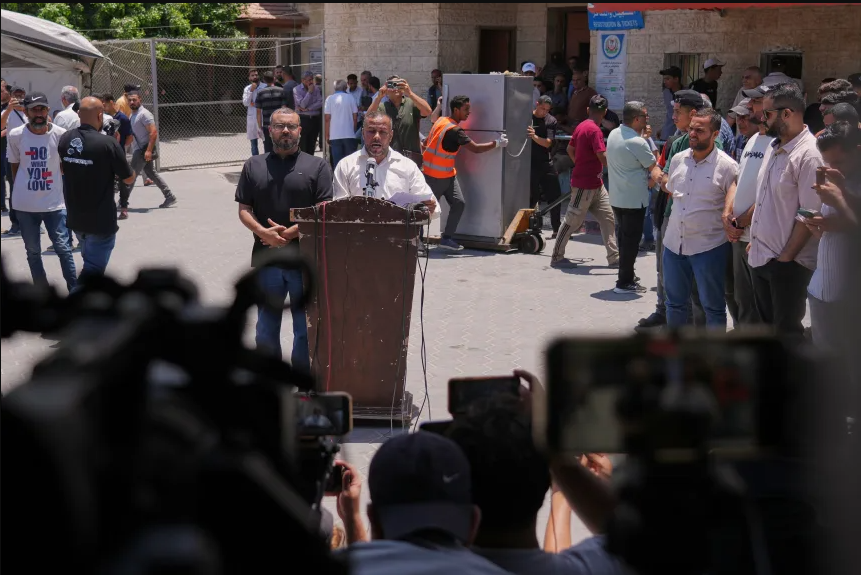
The Palestinian militant organization issued a press statement on July 6, 2026, informing that it has taken steps to finalize the transfer of administrative duties to technocrats in the UN-mandated National Committee for the Administration of Gaza, while warning about “ongoing attempts” by the Israeli government to derail the agreement. It wrote:
We call on our mediating brothers and the guarantor states to take urgent action and exert pressure on the occupation to cease its attempts to obstruct the implementation of the agreement, and to expedite allowing the National Committee for the Administration of Gaza to enter the Strip and begin its duties immediately, thereby thwarting the occupation’s plans, strengthening the resilience of our people, and alleviating their suffering.
Following is a translation of the message:
In the Name of Allah, the Most Gracious, the Most Merciful
Press Statement
The Islamic Resistance Movement (Hamas) reaffirms its full commitment to implementing the ceasefire agreement in the Gaza Strip in its entirety and to continuing to act in accordance with it until the administration of the Gaza Strip is fully transferred to the National Committee for the Administration of Gaza.
In this context, we affirm that the responsible step taken by government authorities in the Gaza Strip, namely, the dissolution of the Government Emergency Committee and the resignation of its chairman and the acting head of government oversight, Mr. Muhammad Abdul-Khaliq al-Farra, comes as part of the process of finalizing the necessary administrative and legal preparations and arrangements for the transfer of administrative duties to the National Committee for the Administration of Gaza.
We warn against the ongoing attempts by the Zionist occupation to obstruct the implementation of the agreement and derail its course, as well as its efforts to impose a reality of administrative vacuum with the aim of deepening the suffering of our steadfast people and thwarting efforts to restore normal life in the Gaza Strip.
We call on our mediating brothers and the guarantor states to take urgent action and exert pressure on the occupation to cease its attempts to obstruct the implementation of the agreement, and to expedite allowing the National Committee for the Administration of Gaza to enter the Strip and begin its duties immediately, thereby thwarting the occupation’s plans, strengthening the resilience of our people, and alleviating their suffering.
Islamic Resistance Movement – Hamas
Monday, 6 July 2026M
Corresponding to 21 Muharram 1448H
The Context
After ousting the Palestinian Authority, Hamas came to power in Gaza on June 14, 2007. Hamas had previously won the Palestinian legislative elections in 2006 since it seized control from rival Palestinian movement Fatah. Hamas has explicitly stated that it is not relinquishing its political or military presence in Gaza. Hamas announced the formal dissolution of its Gaza governing body on July 6, 2026. In preparation, Hamas formally dissolved its emergency governing committee in January 2026 to clear the way for the NCAG. Hamas sent a letter to its 40,000 civil servants and 10,000 police officers instructing them to cooperate with the NCAG, while attempting to negotiate their integration into the new government. Although Hamas stepped back from direct civilian government to clear the path for a transitional, US-backed technocratic administration, Hamas will continue to watch the developments in Gaza as well as the West Bank. A tactical move rather than a true capitulation, Hamas maintains full control over its military capabilities that Iran’s Islamic Revolutionary Guard Corps and Lebanese Hezbollah helped to build and preserve. Hamas is opposed to surrendering its weapons. Hamas ensures that its military arm Izz ad-Din al-Qassam Brigades will not be dismantled.
This Hamas move is designed to survive amidst Israel’s continuing military operations and to shift international diplomatic pressure toward the Israeli government. The technical and civil service staff will continue their daily activities under the new framework but Hamas will operate influencing and controlling local security, both intelligence and police.
The Background
Harakat al-Muqawamah al-Islamiya (Islamic Resistance Movement) or Hamas is an Islamist organisation. An Islamist organization is driven by the core principle that Islamic law (Shari’a) and religious values should govern all aspects of political, social, and economic life. These groups generally reject secular governance, advocating for societies structured entirely around Quranic teachings and the restoration of a traditional Islamic sociopolitical order.
After the Hamas led October 7 massacre, the group lost support from its own population and from most Muslim governments. With the U.S. mounting pressure on Hamas through Qatar, Turkey and Egypt, the pressure on Hamas to dismantle its structure is sustained. In the face of adversity, Hamas will not compromise its aims and objectives. Without getting into a confrontation, Hamas survival strategy is to take one step backwards and two steps forward. By retreating, Hamas will preserve its regime – its totalitarian ideology, its authoritarian organisation, and, its commitment to destroy Israel and establish a Palestinian state.
Hamas was established as the Palestinian branch of the Muslim Brotherhood. However, Hamas increasingly came under the influence of the Iranian regime and regarded the Ayatollah as the “mujahid leader and martyr of the Islamic Revolution.”[1]
During a meeting with Iranian Foreign Minister Abbas Araghchi on July 4, 2026, Mohammed Darwish, the head of the political bureau of the Hamas “praised the principled and courageous stance of the Supreme Leader, Ayatollah Khamenei, in defending the sacred Palestinian cause and supporting the legitimate resistance of the Palestinian people against the occupation and crimes of the Zionist entity in occupied Palestine.” The Iranian Foreign Minister expressed his “appreciation for the presence of representatives from Hamas and other Palestinian resistance factions at the funeral of the martyred leader, reaffirming the Islamic Republic of Iran’s principled stance of continuing to support the Palestinian cause until the Palestinian people achieve their right to self-determination and an independent Palestinian state is established with Quds as its capital”[2].
The Future
The transition into the next phase of the US-brokered peace plan remains gridlocked. Irrespective of the party in power, Israel will reject any long-term administrative or security model that permits a continued Hamas footprint. Israeli officials, including Prime Minister Benjamin Netanyahu, emphasize that the true sticking point remains Hamas’ disarmament and refusal to surrender its weapons.
Hamas’ announcement of the dissolution of its governing emergency committee in Gaza is a positive. It is in response to the military threat posed by Israel. Israel is refusing to hand immediate control of Gaza to the West Bank-based Palestinian Authority. The Cairo-based NCAG, has faced months of travel blocks and entry denials from Israeli forces. The practical implementation of the power transition remains to be seen.
The U.S.-brokered ceasefire agreement is aimed at unlocking stalled peace negotiations. By Hamas stepping back from day-to-day administration, the implementation of the peace plan is likely.
Conclusion
The transfer of power to the NCAG puts Gaza under the oversight of an international Board of Peace proposed by President Donald Trump. However, operating behind the scenes, Hamas will attempt to retain control of the crossings, ministries, and internal security.
Nonetheless, Hamas should play no role in the management of the enclave.
After the Hamas led massacre on October 7 and the overwhelming response by the Israeli authorities, the Palestinians themselves are aware of the consequences of the return of Gaza to Hamas rule. The Palestinian Authority (PA) should reform itself rapidly and develop a far-reaching plan to extend its governance to Gaza. Reform means the PA should start to rewrite its own textbooks that promote hatred of the Jews and the Israelis. Promoting moderation, toleration and coexistence should be the approach and strategy of both the PA and Israel. In addition to its own efforts at thinking long term, Israel should engage the Israeli Arab leaders to work with the PA. About 2.15 million Arabs live in Israel, making up about 21.1% of the country’s overall population. They are Israeli citizens and permanent residents, comprising mostly Muslims, as well as Druze and Christian communities.
The Palestinian Authority, by working with the international community especially with Israel will be able to restore peace and security in Gaza. This will require Palestinian leadership’s commitment to the security of both Palestinians and Israelis.
—
Rohan Gunaratna is a professor of Security Studies at the S. Rajaratnam School of International Studies at the Nanyang Technological University. He is a trainer for law enforcement, national security and military counter terrorism units; and is the author and editor of over 30 books.
Very detailed and insightful article.
There will be peace in the ME when hostile nations put down their weapons and opt to coexist with Israel in peace