
By Rohan Gunaratna
Introduction
A nation can sustain a fight, only if it can defend itself effectively. Without first securing its population and assets, no nation can win a fight against any other entity. Since the Hamas led massacre on October 7, 2023, Israel has been fighting a seven-front war successfully because of three reasons.
- First, Israel has built a high-grade, high-quality intelligence capacity. Although Israeli intelligence and military failed on October 7, 2023 to protect its citizens and its foreign guests, Israel succeeded in restoring its intelligence credibility and military capabilities.
- Second, Israel has integrated its air, land, sea, cyber and space capabilities with the Israeli home front command to sustain the fight.
- Third, Israel diplomatically engaged the U.S. and a number of other countries to sustain the fight, disrupt Iran’s missile and fissile capabilities, and secure the release of both Israeli and foreign hostages. Israeli diplomacy worked when it’s leaders agreed to work with President Donald J. Trump to move towards a permanent resolution to end the Israeli-Palestinian conflict.
For Israel to achieve this feat, Israel’s air defense capability mitigated the aerial threat posed by Hamas and the Palestinian groups, Lebanese Hezbollah, Yemeni Houthis (Ansarullah) and Iran. When Israel’s air defence system failed to intercept and the projectiles fell on Israeli soil, its home front security command mitigated the harm. This article will outline the paramount importance of a robust air defence system and the home front security command in mitigating the threat.
The Context
Iran, it’s partners and proxies has fired hundreds of ballistic missiles and thousands of drones at Israel across several different attacks in 2024 and 2025. Key attacks include:
- April 2024 Attack: As an act of retaliation for an Israeli strike on its Damascus consulate, Iran launched 120 ballistic missiles and hundreds of drones and cruise missiles toward Israel. Most were intercepted, with minimal damage.
- October 2024 Attack: Iran launched about 200 ballistic missiles in two waves. This attack was in response to the assassinations of Hamas and Hezbollah leaders and was described as having higher success in saturating air defenses than the April attack, with some missiles hitting airbases and residential areas.
- June 2025 Iran-Israel War: Over a 12-day conflict, Iran launched a total of between 500 and 550 ballistic missiles and around 1,000 drones at Israel. This conflict saw numerous daily barrages, with dozens of missiles managing to penetrate Israeli air defenses and causing significant damage and casualties.
After Iran’s missile strike in June 2025, the Weizmann Institute of Science faced significant damage, with at least two buildings hit, destroying labs and precious research, including unique biological samples, causing immense loss but sparking remarkable solidarity as scientists rushed to save equipment and relocate freezers amidst the devastation.
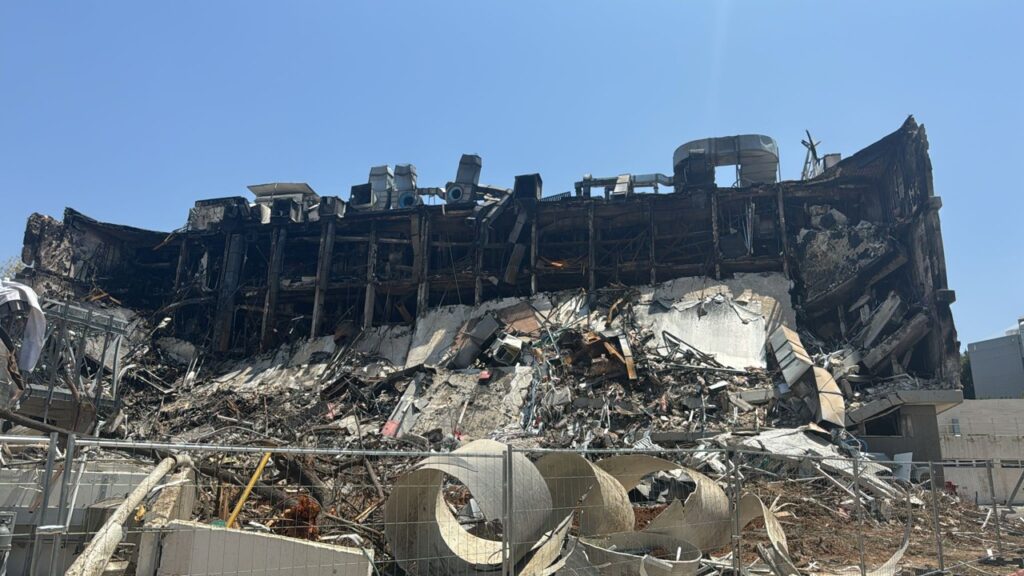
On June 15, 2025, two ballistic missiles from Iran struck the Weizmann Institute of Science, destroying facilities across campus and abruptly halting decades of cutting -edge research.
Overall, the total number of missiles fired is in the high hundreds to over a thousand when all attacks are combined. A significant portion of the incoming projectiles were successfully intercepted by Israel and its allies (including the US and Jordan) using a multi-layered defense system.
Israel is surrounded by hostile neighbours.
Hamas: On the day of the October 7, 2023 attack, Hamas claimed to have fired 5,000 rockets, while the IDF stated 2,200 to 2,500 rockets were launched. Later Israeli sources mentioned a launch of around 4,300 projectiles. The day after the Hamas led attack on October 7, 2023, Iran-sponsored Hezbollah fired over 12,400 rockets, missiles, and other projectiles into Israel from Lebanon.
Hezbollah: Hezbollah has fired over 12,400 rockets, missiles, and other projectiles into Israel from Lebanon since the day after the October 7, 2023 until October 2, 2024. Attacks have utilized a variety of weapons, including high-trajectory fire (rockets and missiles), anti-tank guided missiles (ATGMs), suicide drones (UAVs), and artillery shells.
The attacks have been a near-daily occurrence since October 8, 2023, leading to the displacement of tens of thousands of Israeli civilians from their homes in the north. One of the most intense periods was in November 2024, when Hezbollah fired nearly 200 rockets in a single barrage. Another intense period in September-November 2024, after an escalation in fighting, included 1,285 rocket and missile launches according to Hezbollah’s own data.
These figures do not include projectiles that failed to cross into Israeli territory or landed short in Lebanon.
Ansarallah: The Iran-sponsored Ansarallah of the Houthi movement have fired over 220 missiles, ballistic missiles, and drones toward Israel since the attacks began in October 2023. The IDF reported 40 missiles and 320 drones fired as of January 2025, with the number of missiles increasing significantly by late 2025.
Specific cumulative numbers for missiles fired from March 18, 2025, onward include: 91 ballistic missiles and at least 41 drones as of October 5, 2025. 83 ballistic missiles and at least 36 drones as of July 7, 2025.
Most of the projectiles launched by the Houthis have been intercepted by Israeli or allied air defense systems, such as the Arrow system, or have fallen short of their targets. However, some attacks have reached Israeli territory, including one missile in July 2024 that resulted in one civilian death and several injuries in Tel Aviv, and another that damaged Ben Gurion Airport in May 2025.
Background
The Air Defence Capability
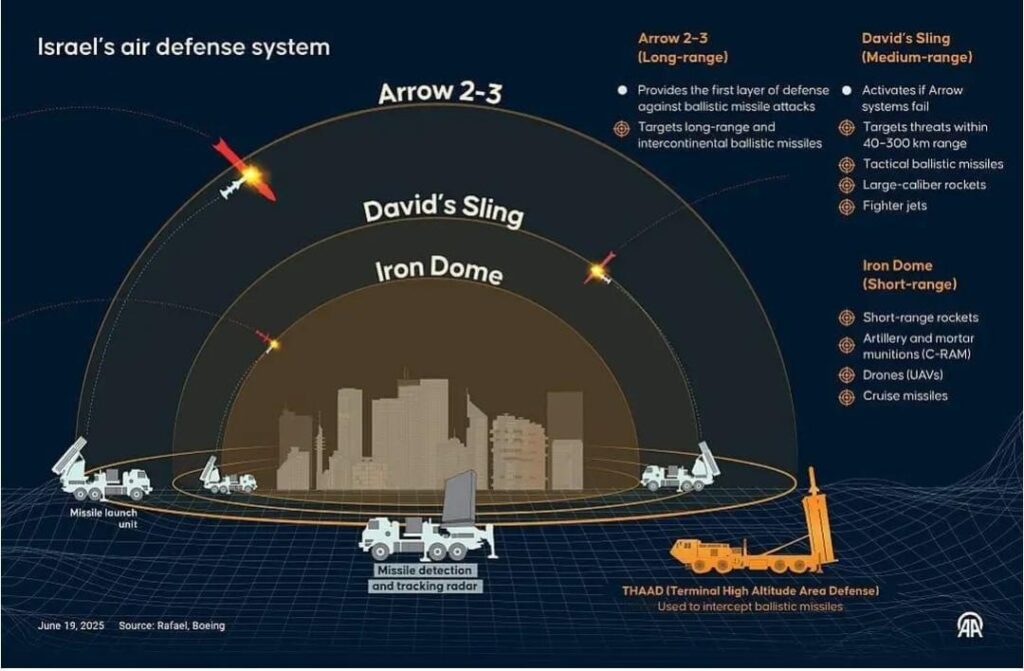
Israeli air defence is a sophisticated, multi-layered system designed to intercept a wide spectrum of aerial threats at different altitudes and ranges. The system integrates several independent components that work together to provide comprehensive coverage.
How the System Works (General Principles)
Each system within the network generally operates using three key components:
- Detection & Tracking Radar: A radar system (like the EL/M-2084 for the Iron Dome) detects incoming projectiles, tracks their speed and trajectory, and sends the data to a control center.
- Battle Management & Control (BMC) Center: Military personnel at a 24/7 command center analyze the data, determine if the incoming object poses a threat to a populated area or critical infrastructure, and decide which defense system is best suited for the interception.
- Launcher & Interceptor Missiles: If a threat is confirmed, the system fires one or more interceptor missiles to destroy the incoming projectile in the air, often using a fragmentation warhead that detonates nearby.
The Multi-Layered Defense Architecture
Israel’s air defense is structured in several tiers to handle different types of threats:
Lowest Tier (Short-Range): Iron Dome
Purpose: Designed to intercept and destroy short-range rockets, artillery shells, and drones (4-70 km range).
Mechanism: It only targets rockets projected to hit populated areas, allowing others to land harmlessly in open ground. The Tamir interceptor missiles detonate near the target, destroying it mid-air.
Effectiveness: It has a claimed success rate of over 90% against relevant threats.
Low to Medium Altitude: Iron Beam & Barak MX
The Iron Beam is a new, not fully operational, laser-based system that uses a high-energy beam to shoot down small, short-range threats like drones and mortars at a very low cost per shot.
Barak MX is a versatile ground and naval-based system capable of intercepting advanced aircraft, cruise missiles, rockets, and tactical ballistic missiles.
Medium to Long-Range: David’s Sling
Purpose: Counters medium- to long-range threats, including large-caliber rockets, cruise missiles, and ballistic missiles.
Mechanism: It uses “Stunner” interceptors with hit-to-kill technology (though some sources mention proximity detonation) to destroy targets at ranges up to 300 km.
Collaboration: Developed jointly by Israel’s Rafael Advanced Defense Systems and the US firm Raytheon.
Upper Tier (Long-Range): Arrow 2 & Arrow 3
Purpose: The top layer of defense, designed to intercept long-range ballistic missiles, including those that can carry nuclear, chemical, or biological warheads.
Arrow 2: Intercepts incoming missiles in the upper atmosphere, using a fragmentation warhead.
Arrow 3: Intercepts threats in space, outside the Earth’s atmosphere, using “hit-to-kill” technology to eliminate the warhead before it re-enters the atmosphere.
Additional Systems & Allies:
Israel also operates U.S.-supplied Patriot systems and the Terminal High Altitude Area Defense (THAAD) system, which the U.S. has sent to bolster Israel’s defenses against ballistic missiles. Fighter jets, such as the F-35 stealth aircraft, are also used for air-to-air interception of drones and cruise missiles.
This integrated approach allows Israel to address incoming threats at the most effective altitude and range, maximizing defensive success rates and minimizing potential damage on the ground.
The Role of the Home Front Command
After the October 7, 2023, attack, the Israeli Home Front Command’s role became critical in managing the civilian response to constant threats, including issuing emergency alerts, defining civil defense guidelines, and managing search and rescue efforts.
Key Actions and Developments
Declaration of “Special Situation”:
On the morning of October 7, 2023, a “special situation on the home front” was declared for the entire country, which granted the military the authority to restrict gatherings and close off areas. This status was extended multiple times but eventually lifted for southern Israel in late October 2025, reflecting a perceived new security reality in the area.
Civilian Guidelines:
The Home Front Command (HFC) provided specific, constantly updated instructions to the public regarding behavior, including directives on where to find protected spaces/bomb shelters and ensuring they were stocked with supplies. These guidelines, available on their official website (oref.org.il), are designed to save lives.
Alert Systems:
The HFC manages the national alert system for incoming missiles and drones. Following the initial attacks, they refined their geolocated targeting technology to provide more precise, location-specific warnings. They also updated their systems to give earlier warnings for long-range threats, such as those from Yemen.
Operational Readiness and Failures:
The HFC has been central to maintaining operational continuity during the conflict, working with local authorities to support residents and enhance resilience. However, post-conflict reports and investigations have identified intelligence failures leading up to the October 7 attack, with a dramatic warning from an IDF unit being sent via email to the HFC’s Southern District base but not acted upon effectively due to protocol failures.
Humanitarian Aid:
The Home Front Command’s National Rescue Unit, known for its international humanitarian aid efforts (e.g., in Turkey and Florida), has also been active in search and rescue missions during the ongoing crisis.
The command continues to emphasize the importance of citizens staying alert and following official instructions. For the latest guidelines, residents rely on the official Home Front Command website or its mobile application.
Conclusion
To strengthen Israel’s offensive and defensive capacity, the US will boost the Israeli missile budget. A new U.S. defense bill was passed on December 10, 2025 with major shifts in its defense grants to Israel.
The bill maintains overall missile-defense funding for Israel but shifts priorities dramatically: Iron Dome allocations are reduced, while funding for the long-range Arrow 3 interceptor system is significantly increased, alongside additional support for anti-tunnel and counter-drone technologies.
The updated Israeli defense structure reflects a strategic shift toward preparing for Iranian ballistic-missile threats rather than primarily Gaza-based rocket fire. Iran is determined to produce a fully functional nuclear weapon and support its partners and proxies with missiles and drones. To protect itself from the Iranian threat, Israel and the U.S. will work together. In the foreseeable future, Israel and the U.S. will work together to dismantle Iran’s missile and fissile capabilities.
The Author: Prof Rohan Gunaratna is the editor of the Handbook of Terrorism in the Middle East. He teaches national security and intelligence and homeland security and counter terrorism to military, law enforcement and intelligence personnel.