
By Rohan Gunaratna
Introduction
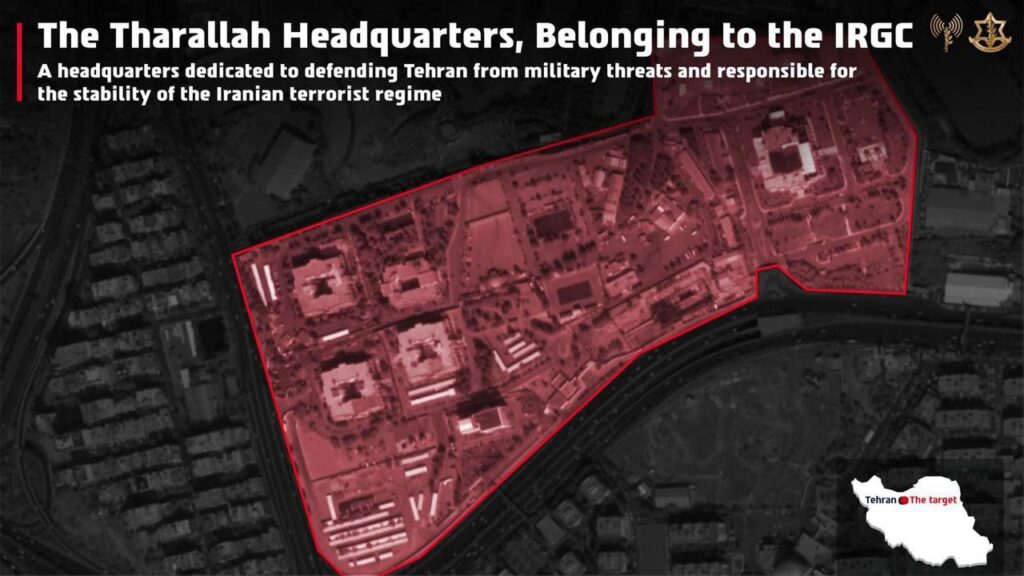
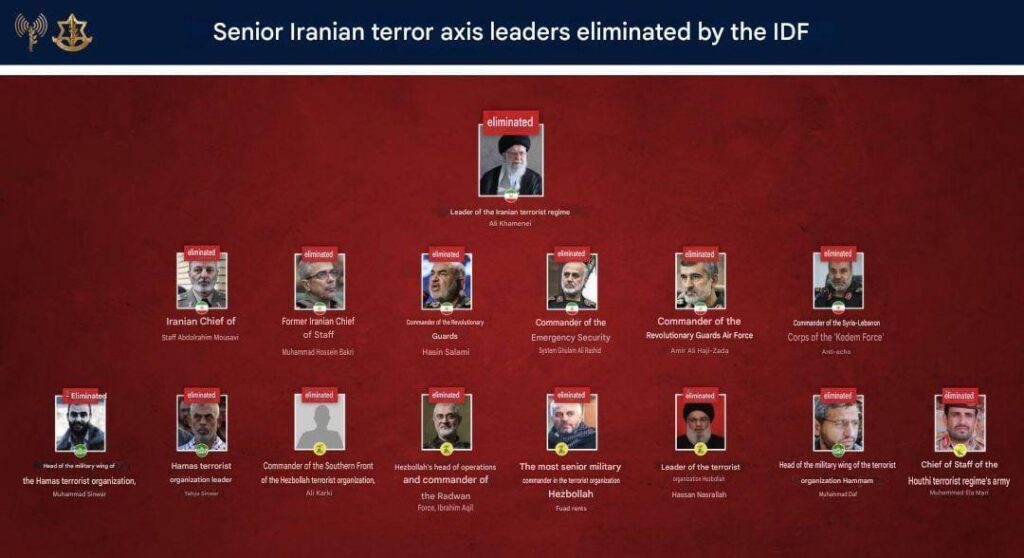
The US and Israeli military and intelligence community jointly launched a sustained series of high intensity and focused operation targeting Iranian political and military leadership and military and other strategic sites starting at 8.10 am on February 28, 2026. The US and Israel developed high grade-high quality intelligence of an impending Iranian attack on Israel. Based on CIA intelligence, the fighter jets of the Israeli Defence Forces (IDF) struck the Leadership House in Tehran eliminating the Iranian Supreme Leader Ayatollah Ali Khamenei and his close team. The spiritual and political leader of Iran, Khamenei defined the regime by nearly building a functional nuclear weapon and other capabilities. In revenge for the US killing of the late Lt. General Qasem Soleimani, who spearheaded a global network of terrorist groups, Khamenei personally ordered the assassination of Donald J. Trump.
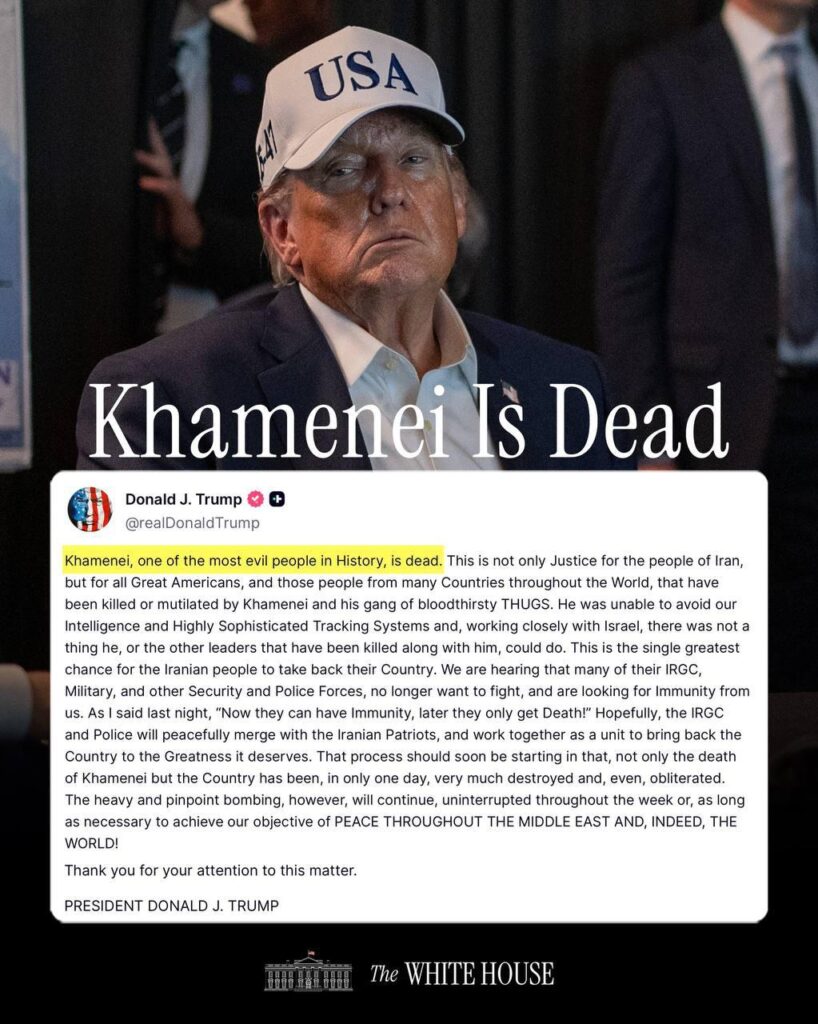
“Khamenei, one of the most evil people in History, is dead,” Trump declared. “This is not only Justice for the people of Iran, but for all Great Americans, and those people from many Countries throughout the World, that have been killed or mutilated by Khamenei and his gang of bloodthirsty THUGS.”
Israeli Prime Minister Benjamin Netanyahu stated, “In a powerful surprise attack this morning, we destroyed the compound of the tyrant Khamenei,” adding, “Signs are increasing that Khamenei is no longer with us.”
The Context
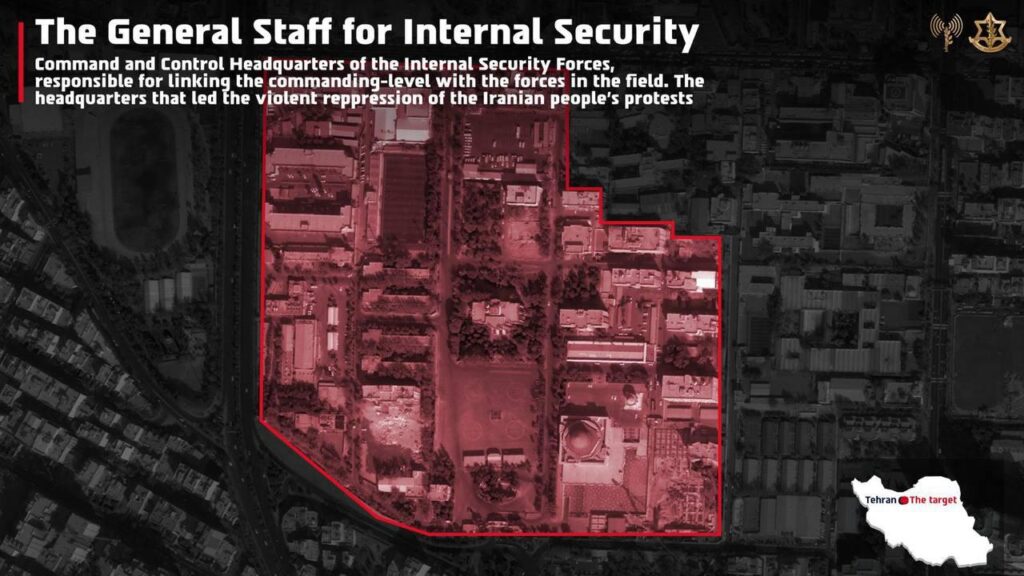
While the Pentagon named its campaign “Epic Fury,” Israel named its campaign “Lion’s Roar”. Focusing on decapitation of high value targets, the IDF together with the US struck launch sites and missile depots, nuclear and other strategic sites, selected energy assets, Uranium mines, and land, sea and air force bases.
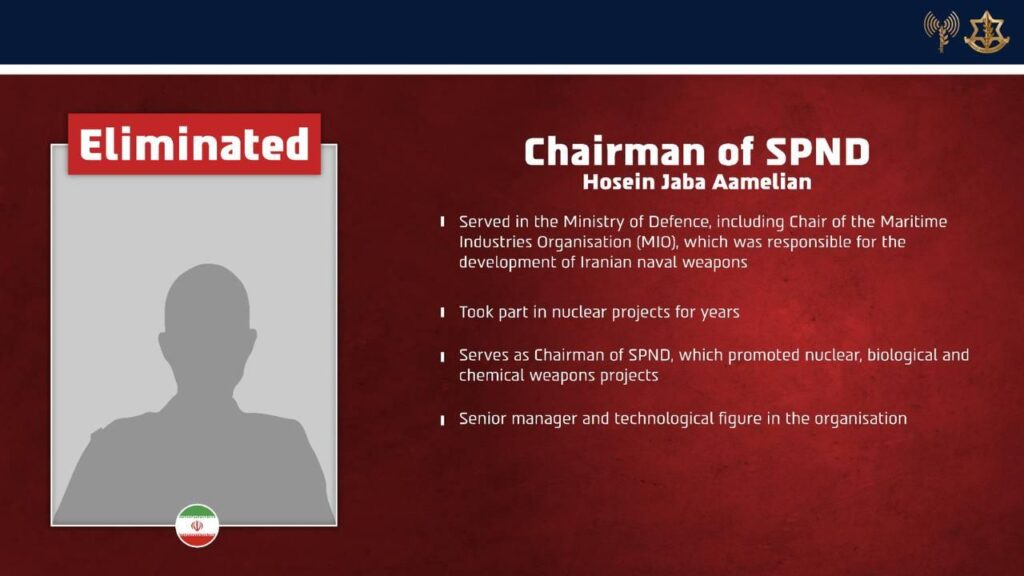
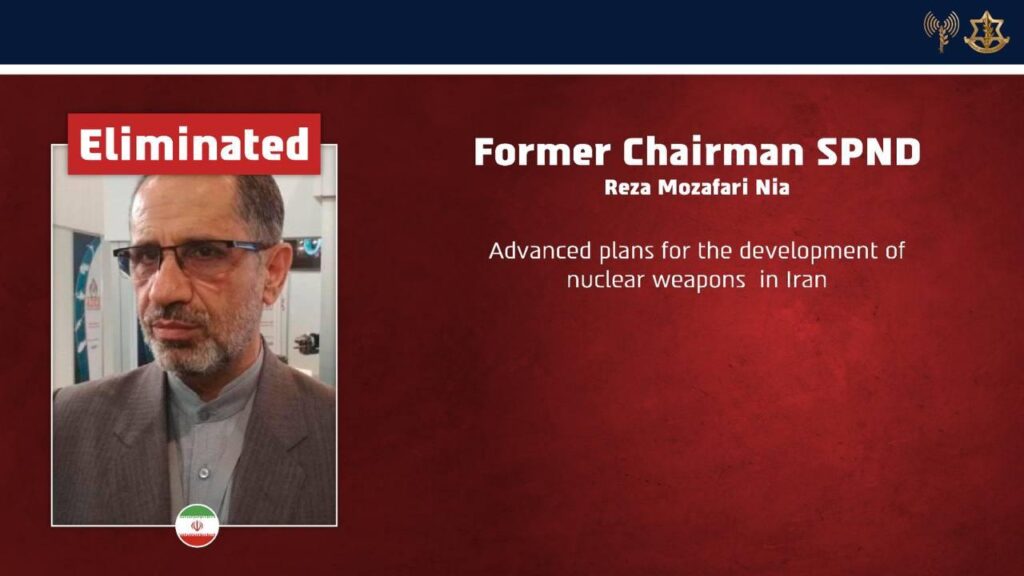
Among the leaders identified for elimination were Ayatollah Ali Khamenei, Supreme Leader, Mohammad Pakpour, commander of Iran’s Islamic Revolutionary Guard Corps (IRGC); Ali Shamkhani, secretary of Iran’s Supreme National Security Council; Amir Nasirzadeh, Iran’s defense minister; Brig. Gen. Majid Khademi, the head of Intelligence Organisation of IRGC; and Major General Sayyid Abdolrahim Mousavi, Iran’s armed forces Chief of Staff (Artesh), Javad Pourhossein, head of foreign intelligence division, Mohammad Reza Bajestani, chief of the security branch, Ali Kheirandish, director of counterterrorism operations and Saeed Ehya Hamidi, an adviser overseeing the war portfolio with Israel. While the serving Iranian President Masoud Pezeshkian survived, the former Iranian president Mahmoud Ahmadinejad was also eliminated in the opening strike. Due to meticulous development of intelligence, most of the targets were successfully eliminated by Israel and U.S.
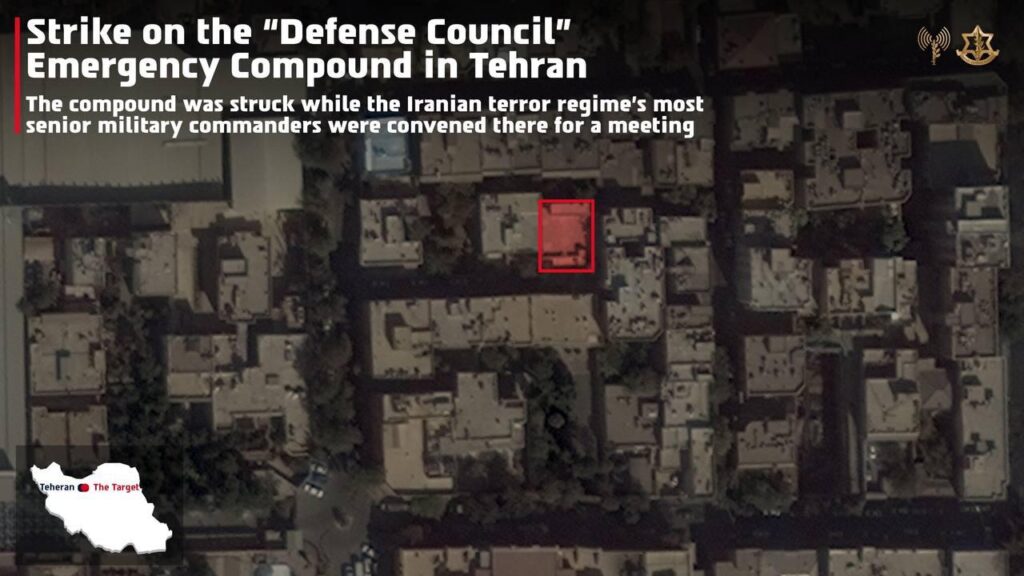
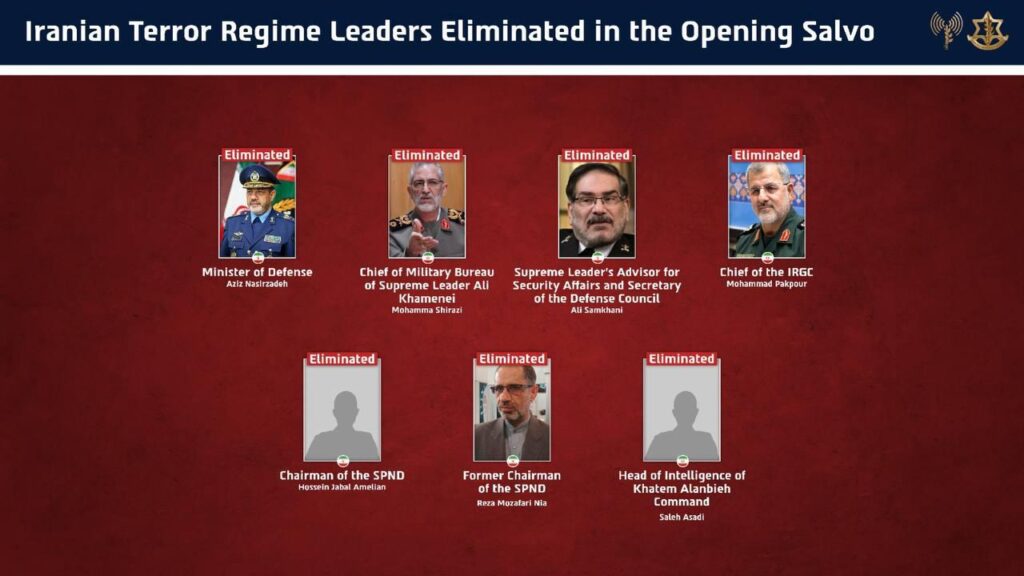
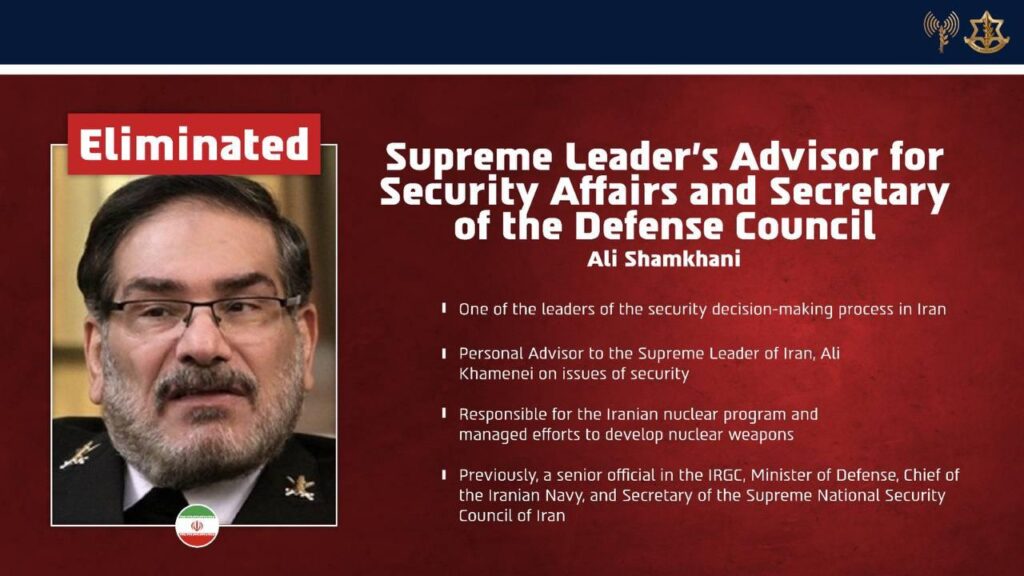
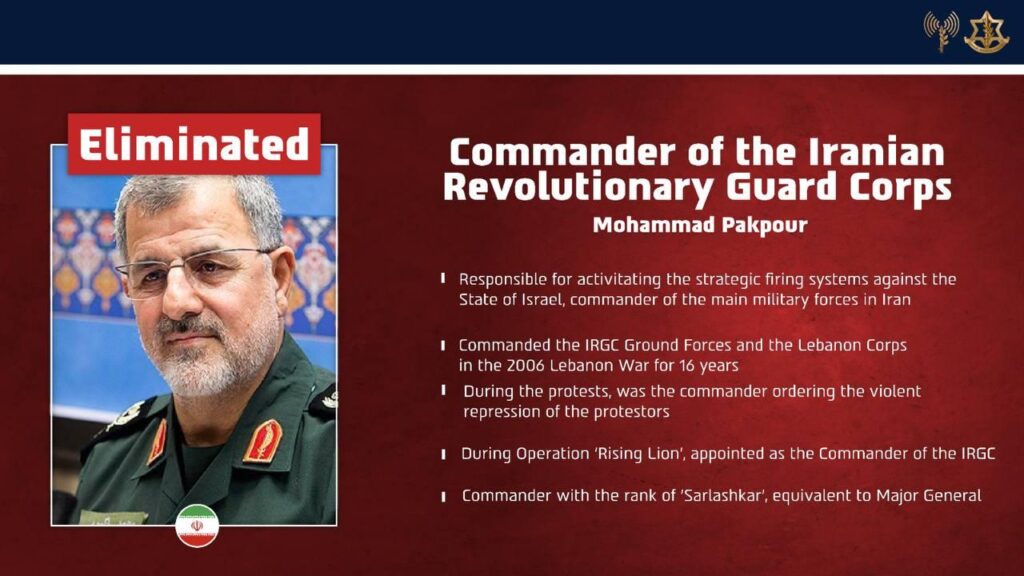
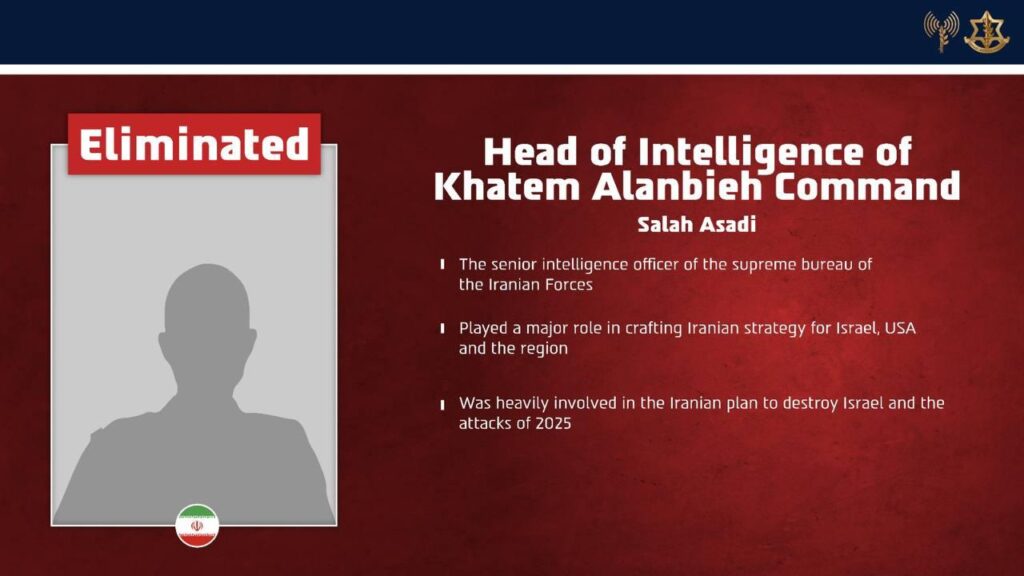
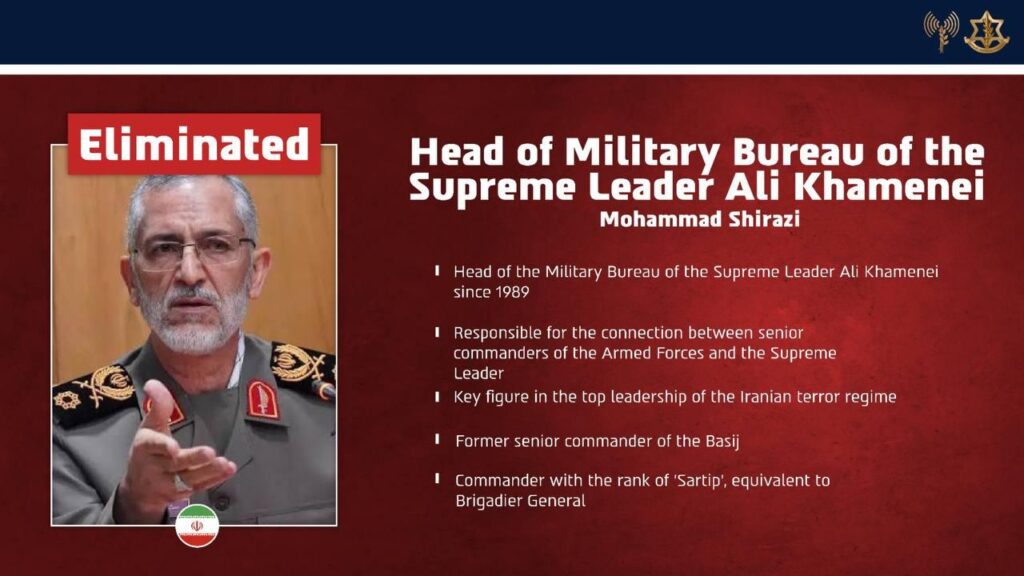
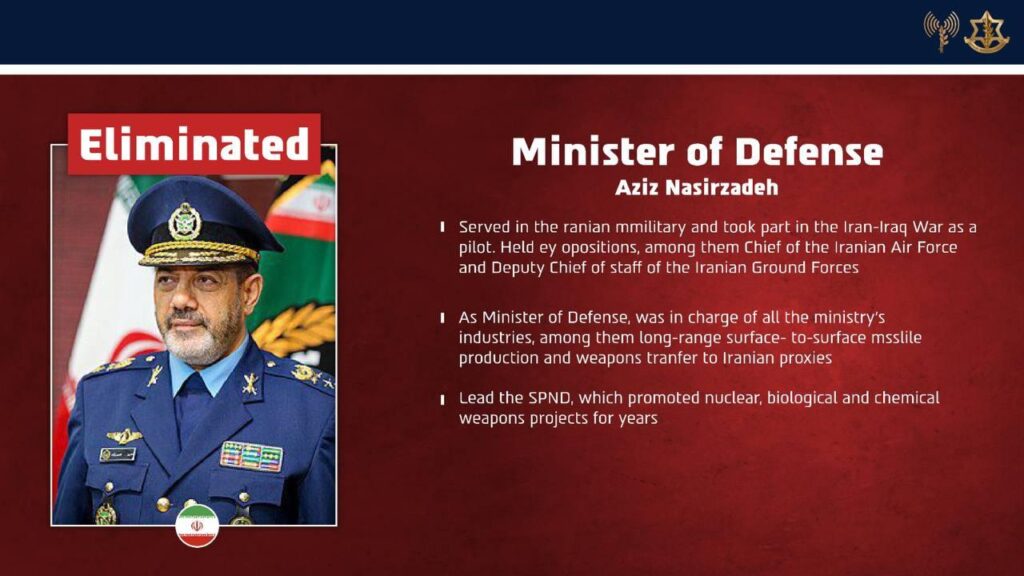
On day one, 200 Israeli fighter jets attacked over 500 targets in Iran. In the first 24 hours, IDF dropped about 1,200 munitions and the Americans about 1,050. While 50 Aerial Refueling Tankers are deployed, there were fewer than 10 in Operation Rising Lion from June 13 -24, 2025. In parallel with decapitation of the Iranian leadership, the IDF struck multiple strategic aerial defense systems, including an advanced SA-65 system in the Kermanshah area of western Iran. To enable strikes inside Iran in the coming days, the IDF completed a broad strike on strategic defense systems of the Iranian regime and established air dominance over Iran.
Trump wrote on Truth Social: “Khamenei, one of the most evil people in History, is dead.”
“He was unable to avoid our Intelligence and Highly Sophisticated Tracking Systems and, working closely with Israel, there was not a thing he, or the other leaders that have been killed along with him, could do. This is the single greatest chance for the Iranian people to take back their Country.”
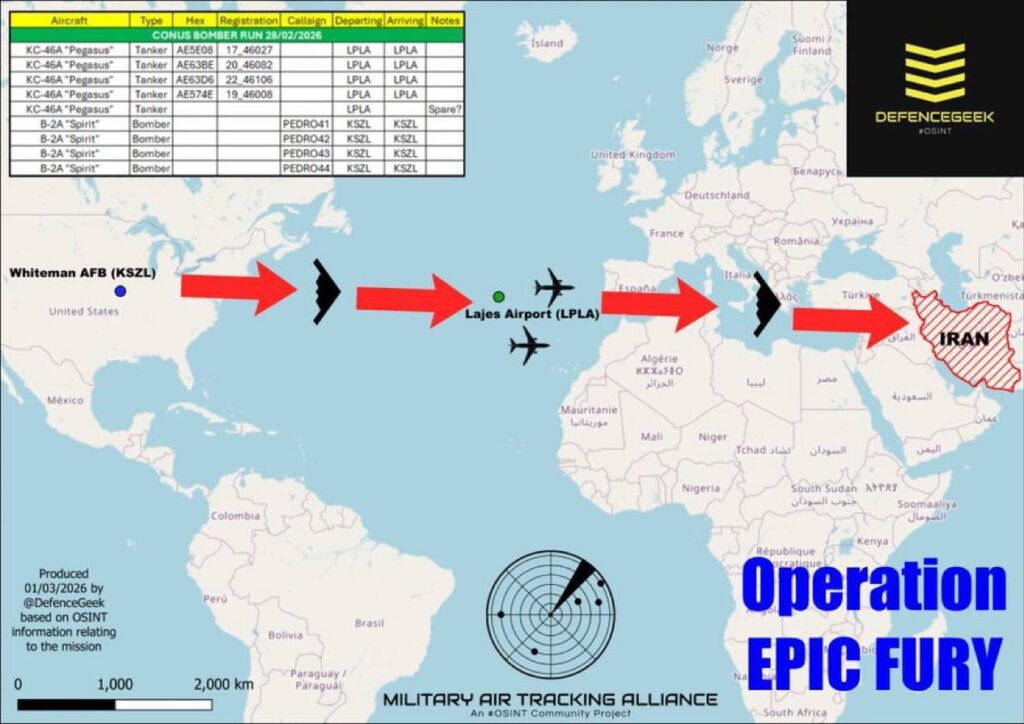
While most of the attacks by the U.S. were launched from their bases in the Middle East, four American B-2 bombers flew from the U.S. and attacked Iran’s missile sites on February 28, 2026.
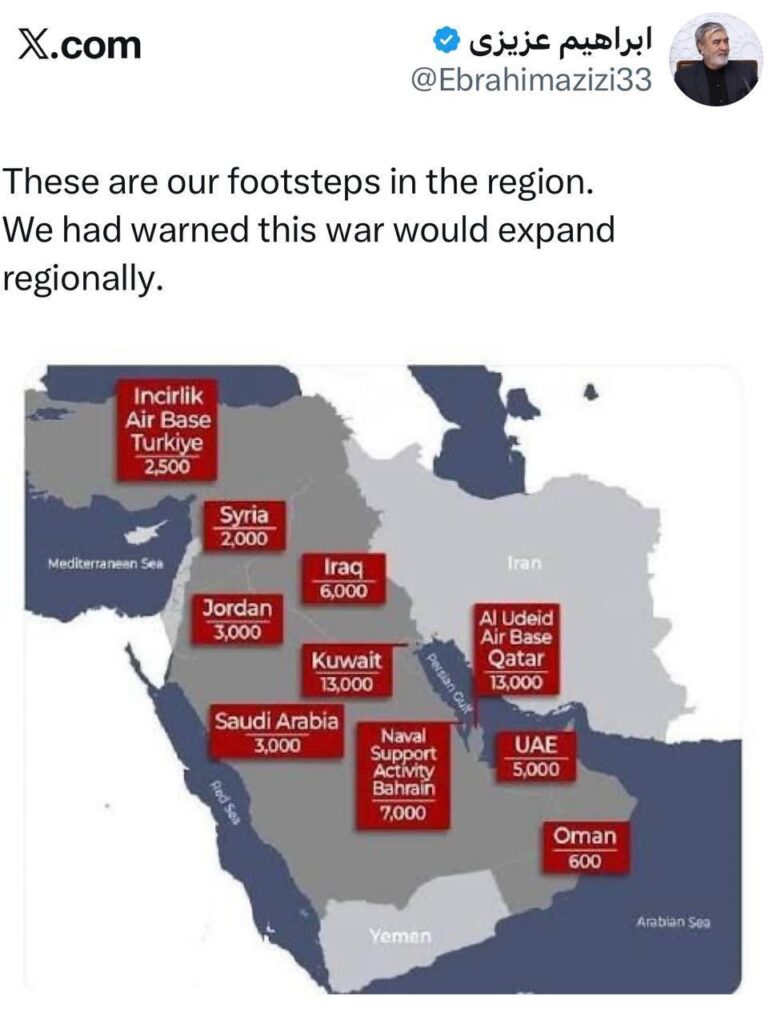
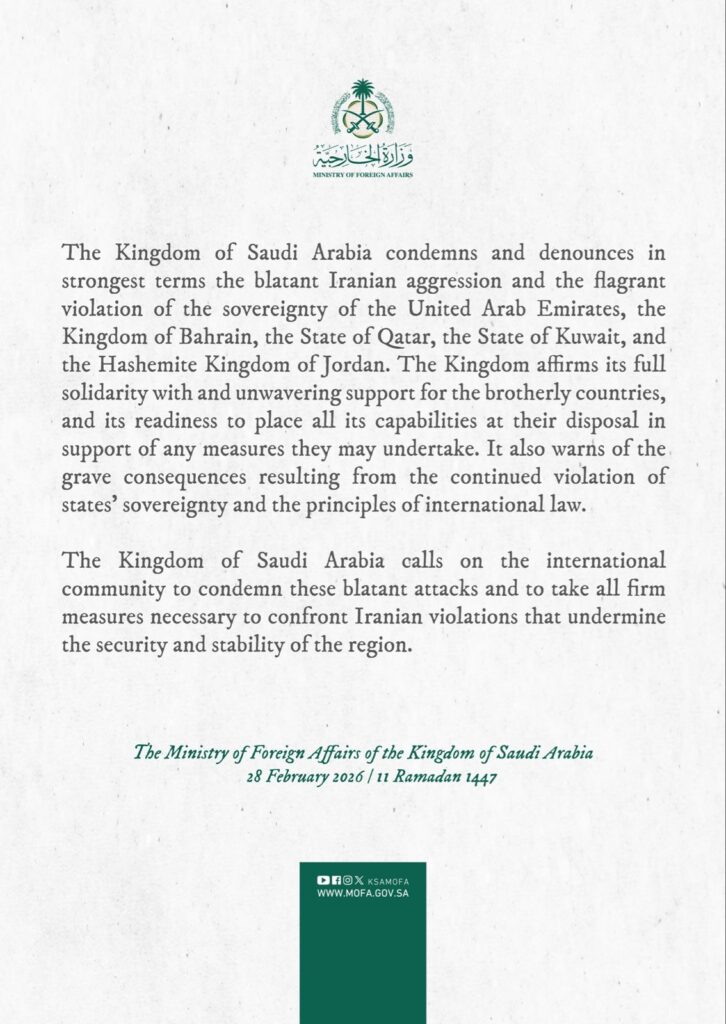
In retaliation, Iran launched operation “True Promise 4” targeting multiple US military bases and civilian targets across the Middle East. Saudi Arabia, UAE, Jordan, Iraq, Bahrain, Kuwait, and Qatar suffered attacks. While their air defenses successfully intercepted most of the incoming missiles and drones, a dozen targets both military and civilian were successfully hit inflicting damage. The regime wants to inflict maximum pain on Gulf states to get them to force Israel and US to stop their campaign. Of the 400 ballistic missiles Iran fired towards Israel on day one, areas in Tel Aviv and Bnei Brak suffered direct hits resulting in two dozen casualties.
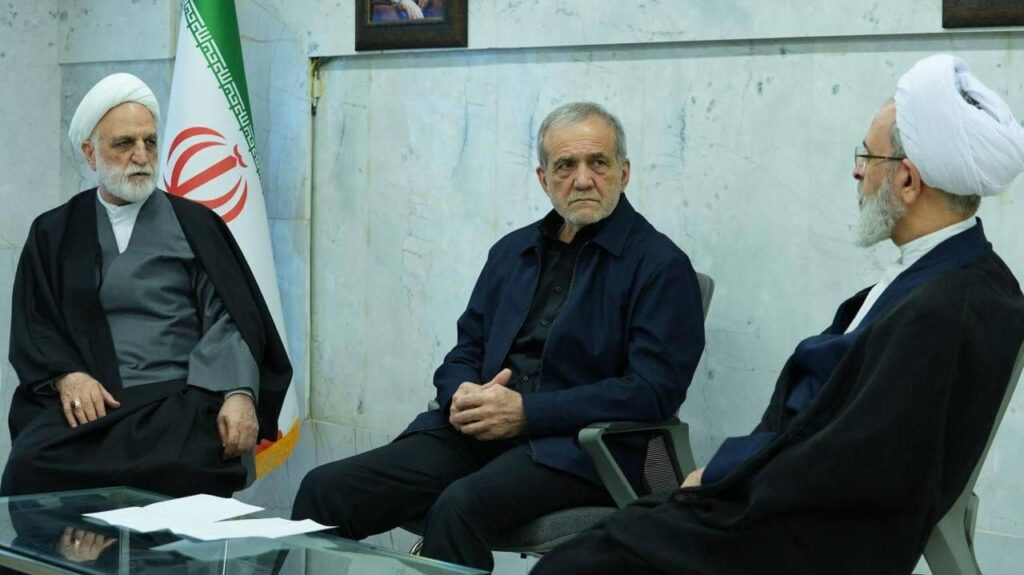
While some Iranians mourn the death of Khamenei, the protesters celebrated the death of the man who brutally suppressed them. The killing of several thousand protesters by the Ayatollah regime emboldened Iranians to call for regime change. After surviving decapitation strikes Iranian President Pezeshkian said on March 1, 2026, “Our dear leader, Imam Khamenei, was martyred at the hands of the wicked American-Zionist alliance, and I offer my condolences to the Iranian nation. The temporary leadership council, consisting of myself, Mr. Ejei (Chief Justice) and Ayatollah Arafi has started its work- and will continue the path.”
Ayatollah Alireza Arafi, the former head of Iran’s seminaries, will serve as a temporary successor to Khamenei. For the apex leadership post, Khamenei’s second son, Mojtaba, has the support of IRGC, the most powerful military, security and intelligence organisation in Iran. While an elected body of 88 senior clerics, known as the Assembly of Experts, will select the next leader.
Background
With the Iranian regime unwilling to compromise on its fissile, missile and proxy programs, the indirect negotiations between the U.S. and Iran in Geneva broke down. With the US deployment of about a third of its air and naval assets in the Middle East by February 26, 2026, the US and Israel decided to strike Iran. The US assets included two aircraft carriers including USS Abraham Lincoln and its super carrier USS Gerald R. Ford. Never has the US deployed this much force against a potential enemy and not launched strikes.
Dismantling Iran’s fissile, missile and proxy programs is the stated aim of the U.S. and Israel. However, unless there is sustained military and political pressure to change the regime, sooner or later Tehran will restore their conventional and Irregular Warfare capabilities.
A limited strike by the US on Iran’s nuclear sites and enrichment facilities on June 21, 2025 disrupted but did not dismantle Iran’s military nuclear program. Although there are no signs of a U.S. ground force that will occupy Iran, there is significant domestic opposition against the Ayatollah regime after Khamenei. The anti-Iranian regime protests have grown both at home and overseas. The protests began on December 28, 2025 in Tehran’s Grand Bazaar, initially sparked by a collapse of the Iranian rial and soaring inflation. Despite the violent suppression of protests by the Iranian regime in January 2026, the Iran-wide protests resumed on February 17, 2026. The protests will persist until the regime is replaced.
Highly deceptive, Iran adopted a strategy to buy time when faced with an existential threat. While threatening to turn the war into a regional conflict, Tehran invested in diplomatic negotiations to help regime survival and revival. After the U.S.-Israel strike on February 28, 2026 there is sufficient momentum to replace the regime helmed by clerics that has ruined the Persian civilisation and divided the Middle East. To restore global stability, regional security and economic prosperity in Iran, a window of opportunity created on day one needs to be harnessed.
Day One: Netanyahu statement
Netanyahu; Israeli Prime Minister Benjamin Netanyahu spoke in Hebrew on the joint U.S.-Israel strike that began on February 28, 2026:
“My brothers and sisters, citizens of Israel, a short while ago, Israel and the United States embarked on an operation to remove the existential threat posed by the terrorist regime in Iran.
I thank our great friend, President Donald Trump, for his historic leadership.
For 47 years, the Ayatollah regime has called for ‘Death to Israel’ and ‘Death to America.’ It has spilled our blood, murdered many Americans, and massacred its own people.
This murderous terrorist regime must not be allowed to arm itself with nuclear weapons that would enable it to threaten all of humanity.
Our joint action will create the conditions for the brave Iranian people to take their destiny into their own hands.
The time has come for all segments of the people in Iran – the Persians, the Kurds, the Azeris, the Balochis, and the Ahwazis – to rid themselves of the yoke of tyranny and bring about a free and peace-seeking Iran.
I appeal to you, citizens of Israel, to comply with the directives of the Home Front Command. The coming days of Operation Roaring Lion will demand patience and fortitude from all of us.
We shall stand together, fight together, and ensure the eternity of Israel together.”
Day One:Trump statement
US: On the U.S. operation targeting the Iranian regime, Trump delivered an address from his Mar-a-Lago resort in Florida.
“A short time ago, the United States military began major combat operations in Iran. Our objective is to defend the American people by eliminating imminent threats from the Iranian regime. A vicious group of very hard, terrible people. Its menacing activities directly endanger the United States, our troops, our bases overseas, and our allies throughout the world.
For 47 years, the Iranian regime has chanted Death to America and waged an unending campaign of bloodshed and mass murder, targeting the United States, our troops and the innocent people in many, many countries. Among the regime’s very first acts was to back a violent takeover of the U.S. Embassy in Tehran, holding dozens of American hostages for 444 days. In 1983, Iran’s proxies carried out the marine barracks bombing in Beirut that killed 241 American military personnel.
In 2000, they knew and were probably involved with the attack on the USS Cole. Many died. Iranian forces killed and maimed hundreds of American service members in Iraq. The regime’s proxies have continued to launch countless attacks against American forces stationed in the Middle East in recent years, as well as U.S. naval and commercial vessels and international shipping lines. It’s been mass terror, and we’re not going to put up with it any longer.
From Lebanon to Yemen and Syria to Iraq, the regime has armed, trained and funded terrorist militias that have soaked the earth with blood and guts. And it was Iran’s proxy, Hamas, that launched the monstrous Oct. 7 attacks on Israel, slaughtering more than 1,000 innocent people, including 46 Americans, while taking 12 of our citizens hostage. It was brutal, something like the world has never seen before.
Iran is the world’s number one state sponsor of terror, and just recently killed tens of thousands of its own citizens on the street as they protested. It has always been the policy of the United States, in particular my administration, that this terrorist regime can never have a nuclear weapon. I’ll say it again, they can never have a nuclear weapon. That is why in Operation Midnight Hammer last June, we obliterated the regime’s nuclear program at Fordo, Natanz and Isfahan. After that attack, we warned them never to resume their malicious pursuit of nuclear weapons, and we sought repeatedly to make a deal. We tried. They wanted to do it. They didn’t want to do it. Again they wanted to do it. They didn’t want to do it. They didn’t know what was happening. They just wanted to practice evil. But Iran refused, just as it has for decades and decades.
They’ve rejected every opportunity to renounce their nuclear ambitions, and we can’t take it anymore. Instead, they attempted to rebuild their nuclear program and to continue developing the long range missiles that can now threaten our very good friends and allies in Europe, our troops stationed overseas, and could soon reach the American homeland. Just imagine how emboldened this regime would be if they ever had, and actually were armed with nuclear weapons as a means to deliver their message.
For these reasons, the United States military is undertaking a massive and ongoing operation to prevent this very wicked, radical dictatorship from threatening America and our core national security interests. We’re going to destroy their missiles and raze their missile industry to the ground. It will be totally again obliterated. We’re going to annihilate their navy. We’re going to ensure that the region’s terrorist proxies can no longer destabilize the region or the world and attack our forces, and no longer use their IEDs, or roadside bombs as they are sometimes called, to so gravely wound and kill thousands and thousands of people, including many Americans. And we will ensure that Iran does not obtain a nuclear weapon. It’s a very simple message. They will never have a nuclear weapon.
This regime will soon learn that no one should challenge the strength and might of the United States Armed Forces. I built and rebuilt our military in my first administration and there is no military on earth even close to its power, strength or sophistication. My administration is taking every possible step to minimize the risk to U.S. personnel in the region. Even so, and I do not make this statement lightly, the Iranian regime seeks to kill. The lives of courageous American heroes may be lost, and we may have casualties. That often happens in war. But we’re doing this not for now. We’re doing this for the future. And it is a noble mission. We pray for every service member as they selflessly risk their lives to ensure that Americans and our children will never be threatened by a nuclear-armed Iran. We ask God to protect all of our heroes in harm’s way. And we trust that with his help, the men and women of the armed forces will prevail. We have the greatest in the world, and they will prevail.
To the members of the Islamic Revolutionary Guard, the armed forces and all of the police, I say tonight that you must lay down your weapons and have complete immunity. Or in the alternative, face certain death. So, lay down your arms. You will be treated fairly with total immunity, or you will face certain death. Finally, to the great proud people of Iran, I say tonight that the hour of your freedom is at hand. Stay sheltered. Don’t leave your home. It’s very dangerous outside. Bombs will be dropping everywhere. When we are finished, take over your government. It will be yours to take. This will be probably your only chance for generations.
For many years, you have asked for America’s help. But you never got it. No president was willing to do what I am willing to do tonight. Now you have a president who is giving you what you want. So let’s see how you respond. America is backing you with overwhelming strength and devastating force. Now is the time to seize control of your destiny, and to unleash the prosperous and glorious future that is close within your reach. This is the moment for action. Do not let it pass.
May God bless the brave men and women of America’s armed forces. May God bless the United States of America. May God bless you all. Thank you.”
Day One: Iran Ministry of Foreign Affairs statement
Iran: In its first statement since the US and Israel launched their attack on Iran in the morning, the ministry of foreign affairs in Tehran said:
“The renewed military aggression by the United States and the Zionist regime against Iran constitutes a violation of international law and the principles of the United Nations Charter… The Iranian nation has always demonstrated patience and restraint to prevent escalation and preserve regional stability.”
Conclusion
Since the Islamic revolution in Iran in 1979, the Iranian regime was driven by a combination of ideological anti-imperialism, deep-seated security anxieties, a desire for regional hegemony, and the pursuit of regime survival. Tehran views the U.S. as an “oppressive power” and a “Great Satan” that seeks to dominate the Middle East through Israel, the “Little Satan”. In addition to its pursuit of nuclear weapons, Washington views Iran as a destabilising force that sponsors terrorism and engaged in irregular warfare.
By encircling Israel, Saudi Arabia, and, UAE, Tehran sought to curtail U.S. Influence from the Middle East. A primary objective was to force the U.S. to withdraw its military forces from the region, which Iran views as an existential threat to the Islamic Republic. Tehran steadfastly built three capabilities that threatened both the Middle East and the rest of the world.
First, a military nuclear program to build a functional nuclear weapon and capabilities that will start an arms race in the Middle East.
Second, a ballistic missile and a cruise missile program that threaten the Middle East and beyond.
Third, sponsorship of states, insurgent, terrorist and criminal proxies in the Middle East and worldwide that threaten global and regional security.
After the Hamas-led terrorist massacre on October 7, 2023, the US and Israel working with both western and Arab and Muslim partners have effectively broken the back of the Iran axes. The game changer in the Middle East was the US working together with partners in the region to counter the threat posed by Iran and its proxies. In addition to loss of Syria under Bashar al Assad, Iran’s proxies from Hezbollah in Lebanon to Ansar Allah in Yemen were severely weakened.
The US and Israeli strikes supported by most western and Arab governments have created the conditions for regime change. With dwindling public support, the regime in Tehran will capitulate in the short term. Although Iran’s deep state seeks to maintain the clerical regime, the Iranian protest movement is gathering momentum. After the Iranian regime attacked its neighbourhood, there is no more support for Tehran from the Middle East governments. The Ayatollahs that have ruined beautiful Iran will be replaced soon.
Rohan Gunaratna is a professor of Security Studies at the S. Rajaratnam School of International Studies at the Nanyang Technological University. He is a trainer for law enforcement, national security and military counter terrorism units; and is the author and editor of over 30 books, including the Handbook of Terrorism in the Middle East.
Additional material from the International Institute for Strategic Studies
The International Institute for Strategic Studies (IISS) has produced an assessment on the U.S. and Israel campaign to enable regime change in Iran. Titled, “The US-Israel campaign in Iran”, the IISS examines both the threat and response.
Congratulations to Sascha Bruchmann, Air Marshal (Retd) Martin ‘Sammy’ Sampson, Nick Childs, Hasan T. Alhasan, and Dana Allin for their timely contribution.
Writing on the “Phase one of the war to topple the IRGC” Bruchmann and Air Marshal (Retd) Sampson says that “The likely upcoming shift of offensive air operations towards the Iranian security and intelligence apparatus and fielded forces (IRGC, Basij, MoIS, regular forces totalling more than 1.2 million) will require reactive targeting capabilities and more strike capacity. Initial moves have been made with US MQ-9 Reapers already reported to be operating over Tehran and facilitating targeting. The essential campaign enablers (command and control, refuelling, intelligence, electronic attack) required for a tactical shift are close and waiting in the region and the Eastern Mediterranean. Extensive US weapon stocks are pre-positioned in the region but not yet accessible.
With every Iranian strike on the GCC, the regional appetite to relax support, access, basing and overflight restrictions is shifting. Air-campaign planning will have anticipated this.”
Read the full piece here.
First, at the operational level, the U.S.–Israel campaign appears designed as a classic decapitation and degradation strategy—targeting leadership, command-and-control nodes, missile infrastructure, and strategic deterrent capabilities. If the intelligence and strike coordination described are accurate, the scale, tempo, and integration of air dominance, refueling, long-range B-2 missions, and multi-domain targeting represent a highly sophisticated military operation. From a purely military standpoint, this signals overwhelming superiority and deterrence messaging.
However, military effectiveness does not automatically translate into strategic stability.
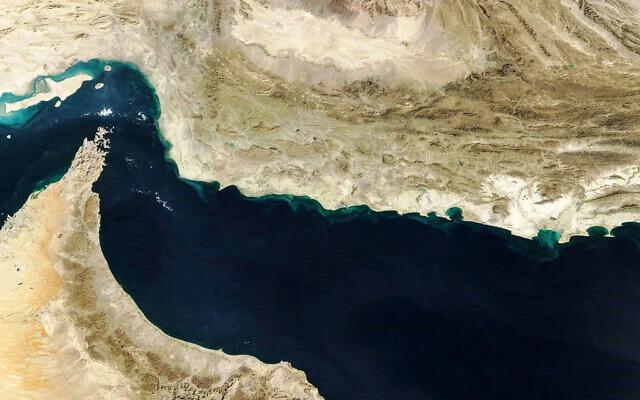
Second, the strategic consequences are far more complex. Eliminating senior leadership can create short-term shock, but history shows that regimes under existential threat often consolidate rather than collapse. Retaliatory missile barrages, attempts to close the Strait of Hormuz, and expansion of the conflict into Gulf states indicate that escalation pathways remain active. The risk matrix now includes:
Regional spillover
Energy market disruption
Maritime chokepoint instability
Proxy reactivation
Great power positioning (Russia/China calculations)
Air dominance does not equal political dominance.
Third, regime change assumptions require caution. External military pressure can create internal opportunity — but it can also generate nationalist backlash. The Iranian protest movement is real, particularly under economic strain, yet regime durability in Iran has historically relied on security consolidation through the IRGC and clerical networks. Whether this moment becomes a tipping point depends less on airstrikes and more on:
Cohesion within the IRGC
Elite fragmentation
Economic collapse trajectory
Popular mobilization capacity
International diplomatic posture
A window of opportunity may exist—but windows close quickly if not paired with political strategy.
Finally, there is the global order dimension. Striking sovereign leadership and strategic infrastructure raises serious international law and escalation questions. If decapitation campaigns become normalized tools of policy, precedent will shape future conflicts beyond the Middle East.
In summary:
Militarily decisive actions can still produce strategic ambiguity.
Regime survival is often political, not purely military.
Escalation control will determine whether this remains a regional war or becomes systemic instability.
The next phase will be defined not by bombing intensity but by political consolidation—inside Iran and across the region.
The coming days will test whether this operation produces deterrence, regime transition, or prolonged regional turbulence.