
By Rohan Gunaratna
Introduction:
The US and Jordanian Air Force conducted airstrikes against Islamic State (IS) targets in Syria on December 20, 2025. In a statement on X, CENTCOM, which directs American military operations in Europe, Africa and the Indo-Pacific, said Operation Hawkeye Strike was launched in Syria. The attack was in response to an IS ambush on American soldiers in Palmyra in Syria on December 13, 2025.
In 2019, a US-backed alliance of Syrian fighters announced that IS had lost the last pocket of territory in Syria it controlled, but since then the group has survived and revived. The IS led global jihad movement not only attacked in Syria but overseas. The IS ideology inspired and instigated groups, networks, cells and individuals to carry out attacks worldwide. The latest IS attack was in Bondi beach in Australia.
The United Nations says the group still has between 5,000-7,000 fighters in Syria and Iraq. The US troops have maintained a presence of a 1000 troops in Syria since 2015 to help train other forces as part of a campaign against the IS.
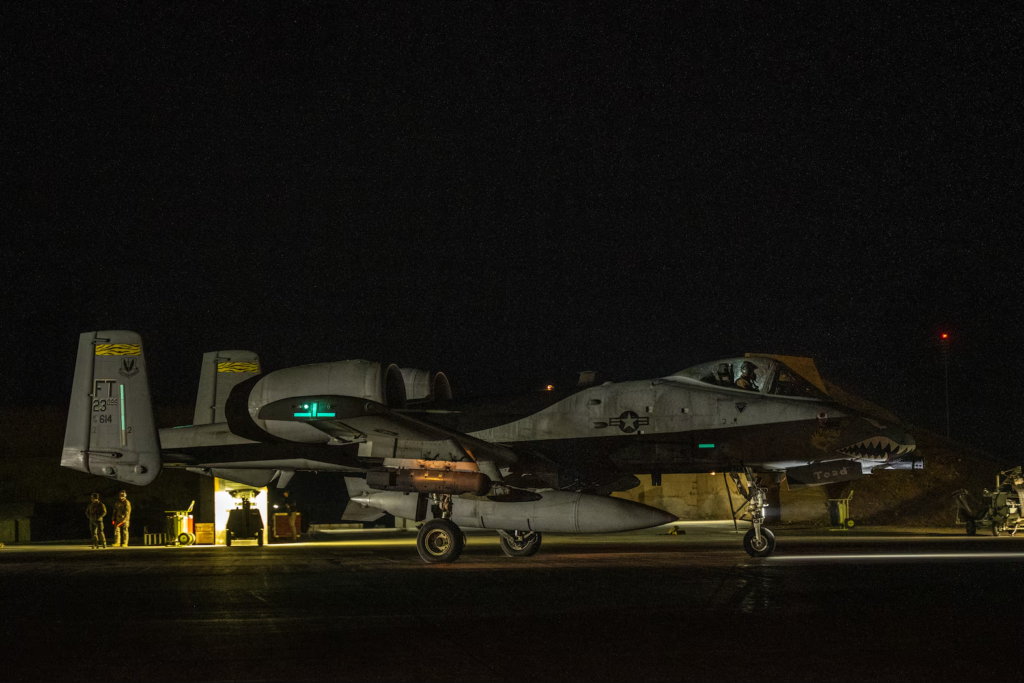
Following the attack on U.S. and partner forces last Saturday, U.S. Central Command (CENTCOM) commenced Operation Hawkeye Strike at 4 pm ET against ISIS in Syria, Dec. 19, at the Commander in Chief’s direction.
CENTCOM forces struck more than 70 targets at multiple locations across central Syria with fighter jets, attack helicopters, and artillery. The Jordanian Armed Forces also supported with fighter aircraft. The operation employed more than 100 precision munitions targeting known ISIS infrastructure and weapons sites.
The Context:
At U.S. President Trump’s direction, “Operation Hawkeye Storm” referring to Iowa, which is known as the Hawkeye State was launched in Syria. Trump vowed revenge on the terror group after the soldiers — Sgt. Edgar Brian Torres-Tovar, 25, of Des Moines, Iowa, and Sgt. William Nathaniel Howard, 29, of Marshalltown, Iowa — and interpreter Ayad Mansoor Sakat of Michigan —were killed while conducting a key leader engagement, part of their mission in support of ongoing counter-ISIS/counter-terrorism operations in the region.
Jordanian and US fighter jets, attack helicopters and other assets conducted a massive strike against the Islamic State attempts to revive in Syria. The US and Jordan launched Operation “Hawkeye Strike” attacking 70 targets using over 100 precision munitions. The U.S. F-15 and A-10 jets, along with Apache helicopters and HIMARS rocket systems were deployed. U.S. and partner forces in Syria have conducted more than 80 operations over the last six months to eliminate IS terrorists posing a direct threat to the United States and regional security.
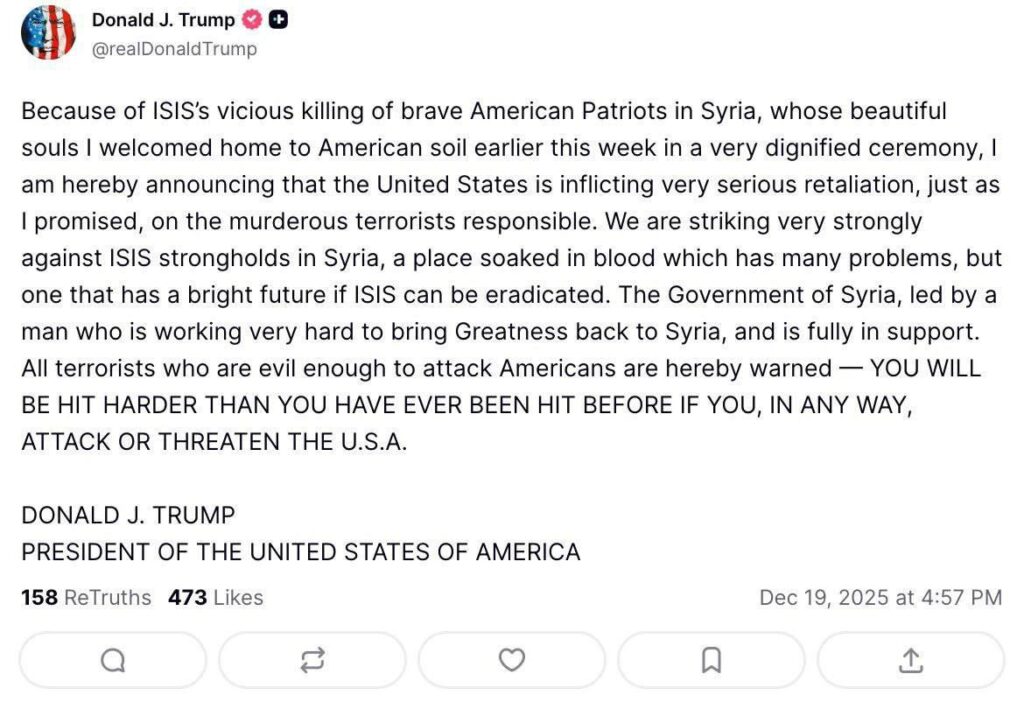
President Donald Trump said “we are striking very strongly” against IS strongholds, following the December 13, 2025 IS ambush in the city of Palmyra in which two US soldiers and a US civilian interpreter were killed.
US CENTCOM commander Admiral Brad Cooper said that the US “will continue to relentlessly pursue terrorists who seek to harm Americans and our partners across the region”. US War Secretary Pete Hegseth said the operation “is not the beginning of a war – it is a declaration of vengeance.
“If you target Americans anywhere in the world you will spend the rest of your brief, anxious life knowing the United States will hunt you, find you, and ruthlessly kill you. Today, we hunted and we killed our enemies. Lots of them. And we will continue,” the US secretary of war added.
President Donald Trump said “we are striking very strongly” against IS strongholds, following the December 13, 2025 IS ambush in the city of Palmyra in which two US soldiers and a US civilian interpreter were killed.
Background;
The territorial “caliphate” of IS was dismantled in March 2019 after U.S.-backed forces captured its last remaining physical stronghold in Baghouz, Syria. This marked the end of the group’s control over a vast area of territory it once held across Iraq and Syria. However, the organization itself was not entirely eliminated.
Since the IS was severely weakened by Kurdish forces working with Western and Arab militaries in late 2018-early 2019, the movement went into remission. Following the loss of its territory, IS transitioned from a quasi-state entity back into a global terrorist and extremist network. Sleeper cells remained active worldwide and a shadow network in Iraq and Syria.
After reconstituting, IS re-emerged and started to conduct attacks periodically. The IS exploited political and security fragilities worldwide especially in countries with weak governments.
The IS also maintained a global network of cells and affiliated groups operating in other regions. In Africa, IS expanded in the Sahel region, Lake Chad, Egypt’s Sinai Peninsula, Libya and in Asia, in Afghanistan, Pakistan, and Philippines. The leader of IS, Abu Bakr al-Baghdadi, was killed in a U.S. raid in northern Syria in October 2019. Although 2019 marked a major military and territorial defeat for IS, its ideology and operational capabilities spread globally.
Conclusion:
Today, the IS and Al Qaeda have reestablished a presence worldwide. Both these groups persist as a long-term threat. With no global strategy to defeat these two Islamist movements, they have revived both in the core and in the periphery. The IS and Al Qaeda periodically stage brutal attacks.
The IS instigated and inspired Sri Lanka’s Easter Sunday massacre targeting churches and hotels in April 2019 to Australia’s Festival of Lights massacre in the Bondi beach in Sidney in December 2025.
Both IS and Al Qaeda affiliates received a boost after Israel responded to a Hamas led massacre of 1200 Israelis and foreigners and abduction of 251 on October 7, 2023. The Salafi – Jihadi infrastructure of madrasahs, mosques and other institutions driving the IS and Al Qaeda threat worldwide remains intact. In addition to the operational threat, the ideological threat has manifested in the digital and public space. However, most governments are unable or unwilling to fight the ideological threat.
—
Rohan Gunaratna is a specialist of the global threat environment. He debriefed Al Qaeda and Islamic State leaders. He is a trainer of law enforcement, national security and military counter terrorism units.