By Rohan Gunaratna
Introduction
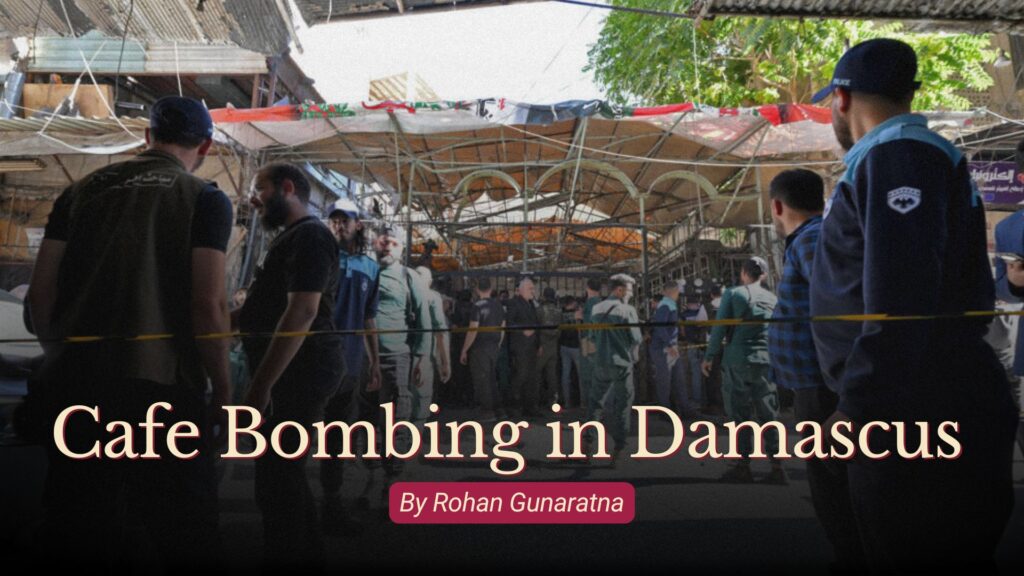
The Islamic State (ISIS) has maintained a low-level insurgency and a terrorist campaign in Syria. Conducting frequent asymmetric operations, the most recent incident is the Damascus Cafe Bombing on July 2, 2026. At least nine people were killed and 22 wounded by an explosive device planted at a crowded cafe near the Palace of Justice. The cafe is one of the busiest in the area, frequented by lawyers, court visitors, and the general public.
The Islamic State also staged the Manbij Ambush in the village of Tahna on June 20, 2026. Islamic State operatives on a motorcycle opened fire with automatic weapons on passing Syrian Arab Army soldiers. The Islamic State claimed responsibility for the attack on military personnel near the northern city of Manbij in Syria’s Aleppo province. The attack targeted Syrian Arab Army under President Ahmad al-Sharaa, previously the leader of Hay’at Tahrir al-Sham (HTS).
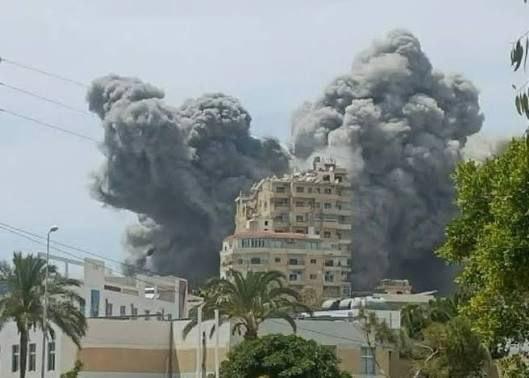
Damascus has been hit by a small number of attacks since the toppling of President Bashar al-Assad in late 2024. His ouster by Ahmed al-Sharaa, now Syria’s president, and his movement HTS effectively ended 14 years of civil war.
The Context
Sunni Islamist militant and political organization HTS evolved from al-Qaeda’s former Syrian affiliate, Jabhat al-Nusra. Under the leadership of Ahmad al-Sharaa alias Abu Muhammad al-Jolani, HTS spearheaded the late-2024 offensives that toppled the Assad regime and currently acts as a leading governing and paramilitary force in northwestern Syria. The HTS was formed in January 2017 as a merger of several opposition factions. It publicly severed ties with al-Qaeda to become a more localized Syrian entity focused on establishing an Islamic state. Retaining a Salafi-jihadist ideology, the group has recently sought to project pragmatism, civil administration expertise, and inclusivity to gain domestic and international legitimacy. However, HTS has targeted Syria’s minorities notably the Kurds, Christians, Druze and Alawites. Historically entrenched in the Idlib province, HTS imposed Sharia, Islamic law when it governed two million people, operating civil ministries through the Syrian Salvation Government. In late 2024, HTS launched a massive offensive, rapidly capturing Aleppo, Hama, and Homs. This culminated in the dramatic downfall of the Assad regime in December 2024. Today, HTS is navigating the complex political realities of a post-Assad Syria, dealing with other rebel factions, local populations, and competing foreign powers. HTS is no longer classified as a Foreign Terrorist Organization (FTO) by major Western powers, but governments are watching the conduct of the Syrian regime. The group’s international standing has not been restored due to its failure to abandon Sharia that has brought immense suffering to the region both to Muslims and non Muslims. The international community should assist the Syrian regime to embrace democracy.
Background
The Islamic State attacks are a part of a series of recurring strikes carried out since February 2026 marking a new phase of operations against the Syrian transitional government. A major prison break occurred on January 19, 2026, when hundreds of Islamic State detainees escaped from detention facilities in northeastern Syria amid heavy fighting between Syrian government forces and the Kurdish-led Syrian Democratic Forces (SDF).
Several hundred Islamic State fighters and terrorist operatives fled from facilities during the chaos. The incident occurred at Shaddadi prison in the Hasakah province and Al-Aqtan prison on the outskirts of Raqqa. The breakout was triggered when Kurdish guards withdrew or lost control due to intense territorial clashes between the SDF and the transitional Syrian government. Both sides blamed each other; the Syrian army accused the SDF of intentional release, while the SDF claimed they were overpowered during military assaults. The security lapse prompted the U.S. military to launch a massive, rapid emergency response to prevent a catastrophic resurgence of the terror network.
Over a three-week period, U.S. forces and CENTCOM helicopters successfully transferred 5,700 to 6,000 high-value Islamic State detainees out of the unstable region to Iraq. The “worst of the worst” adult male fighters were flown directly to high-security detention facilities near Baghdad to ensure tight custody. While thousands of high-profile militants were secured, a portion of the low-level escaped prisoners remain at large in Syria, presenting an ongoing regional security challenge.
One of the first attacks staged by the Islamic State after the prison break was an ambush on a Syrian military transport in the eastern Hasakah countryside, killing two soldiers and wounding several others on May 2026. Since then counterterrorism operations, including U.S. CENTCOM airstrikes and Syrian state security raids, regularly target the remnants of the Islamic State group’s leadership and regional networks.
The Worst Attack
After the transitional government was established, the worst attack conducted in Syria was by the Islamic State. Despite efforts by the Syrian government to dismantle the Islamic State, the group staged attacks intermittently. The first suicide bombing by the Islamic State in Damascus since the fall of the Assad regime in December 2024 targeted the Mar Elias Church on June 22, 2025. An Islamic State suicide bombing in Damascus killed 30 and wounded 54 parishioners. The attacker opened fire and detonated an explosive device inside the Greek Orthodox Mar Elias Church during Divine Liturgy in Damascus. About 350 people were in attendance when the bomber detonated his explosive vest. The explosion caused much damage, breaking glass, destroying pews, collapsing the iconostasis, scattering bodies and splattering blood on the walls, floor and icons. The Democratic Autonomous Administration of North and East Syria condemned the attack, calling it a “despicable form of terrorism,” and expressed condolences to the victims.
The Greek Orthodox Patriarchate of Antioch released a statement saying “The treacherous hand of evil struck this evening, claiming our lives, along with the lives of our loved ones who fell today as martyrs during the evening divine liturgy.” Patriarch John X, speaking at the memorial service in Damascus, stated that the attack was a massacre, a heinous crime, and a targeting of a fundamental component of Syria. He asserted that Syrian Christians were not going anywhere after the attack. Speaking to the current president of Syria Ahmed al-Sharaa, the Patriarch regretted that there were no government officials at the crime scene other than Hind Kabawat, the only Christian in government. He appealed for the government to extend a hand to the Syrian Christian population in building the new Syria. United Nations special envoy Geir Otto Pedersen condemned the attack, calling it a heinous crime and an act of terrorism. The Arab League also condemned the attack. Pope Leo XIV offered his condolences.
Conclusion
The new Islamist government led by Ahmed Al Sharaa should reform. The government should win over minorities by disbanding the jihad militias that form a part of the Syrian military. The government should maintain control and mount operations against terrorist and extremist cells. Most Islamic State attacks have been preempted but the threat persists.
Kurds, Christians, Alawites and Druze have been increasingly concerned that weapons are being freely carried around. The jihadi groups should be disbanded and their members and leaders deradicalised. Muslim sheikhs that visit Damascus and other neighbourhoods asking Christians and other residents to convert to Islam, should be rehabilitated. Instead government should promote moderation, toleration and coexistence.
—
Rohan Gunaratna is a professor of Security Studies at the S. Rajaratnam School of International Studies at the Nanyang Technological University. He is a trainer for law enforcement, national security and military counter terrorism units; and is the author and editor of over 30 books.
Excellent piece Sir. Just would like to understand the dynamics between HTS and IS. In the near future, should Syria expect a turf war between the two?