
By Rohan Gunaratna
Introduction
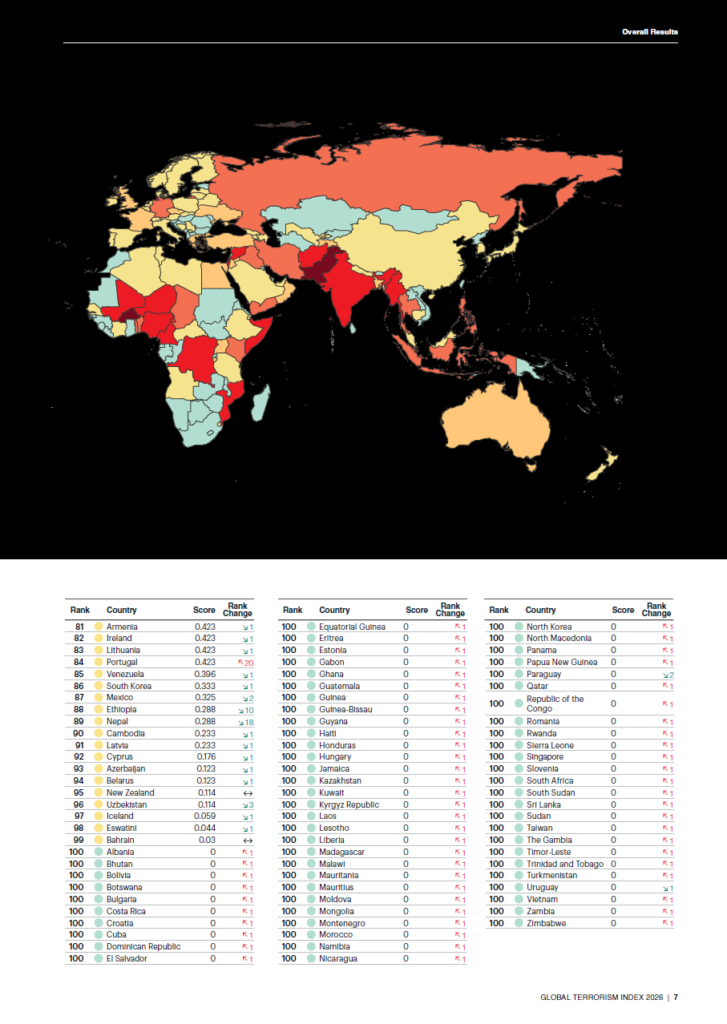
The global terrorism landscape has changed dramatically. Both hostile state actors and non state actors present a threat in the Middle East, Asia and in Africa. While threat in the Middle East persists due to Iran’s sponsorship of terrorism, the threat has expanded in two directions. While an Al Qaeda/Taliban centric Tehreek-e-Taliban Pakistan (TTP) is rated the most violent group in Asia, both Al Qaeda and Islamic State affiliates dominate the violence in Africa.
The Context
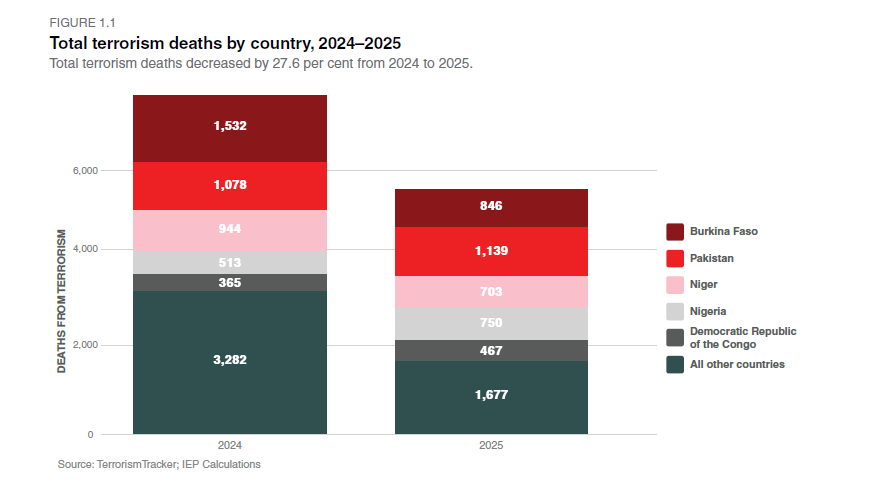
The four deadliest terrorist organisations in 2025 were the Islamic State (IS), Jamaat Nusrat Al-Islam wal Muslimeen (JNIM), Tehrik-e-Taliban Pakistan (TTP), and al-Shabaab. According to the Global Terrorism Index (GTI) 2026[1], these four entities were collectively responsible for 3,869 deaths, or 70 per cent of all terrorism fatalities in 2025. This trend is unlikely to change in 2026.
Asia
Pakistan is now at their highest level of terrorism since 2013. Most terrorist cases are linked to ‘madaris’. They are nurseries for exclusivist, extremism, violence and terrorism. Based on the Pakistan government statistics, GTI 2026 report 1,139 terrorism deaths and 1,045 incidents in 2025[2]. The actual numbers however, are higher.
Africa
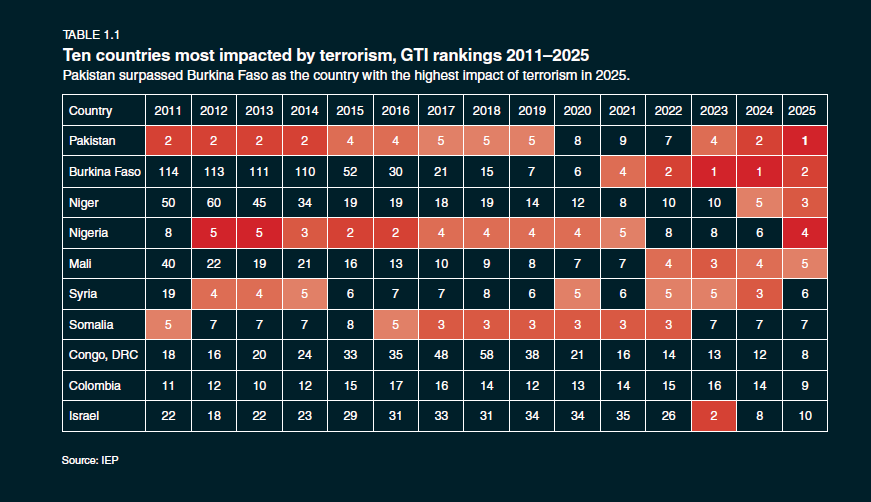
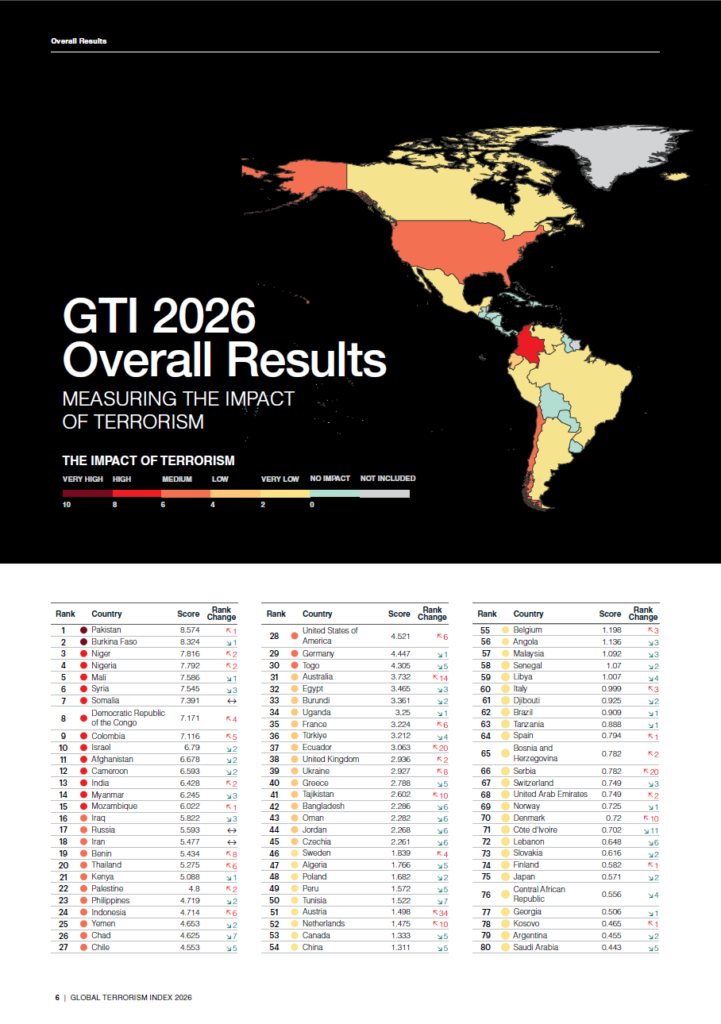
According to GTI 2026, about 70 per cent of deaths from terrorism occurred in five countries – Pakistan, Burkina Faso, Nigeria, Niger, and the Democratic Republic of the Congo (DRC). Except Pakistan, four of the worst affected countries from terrorism are in sub-Saharan Africa. Six of the ten countries most impacted by terrorism are in sub-Saharan Africa[3]. As I have warned continuously over the last couple of years, Africa is the global epicentre of terrorism.
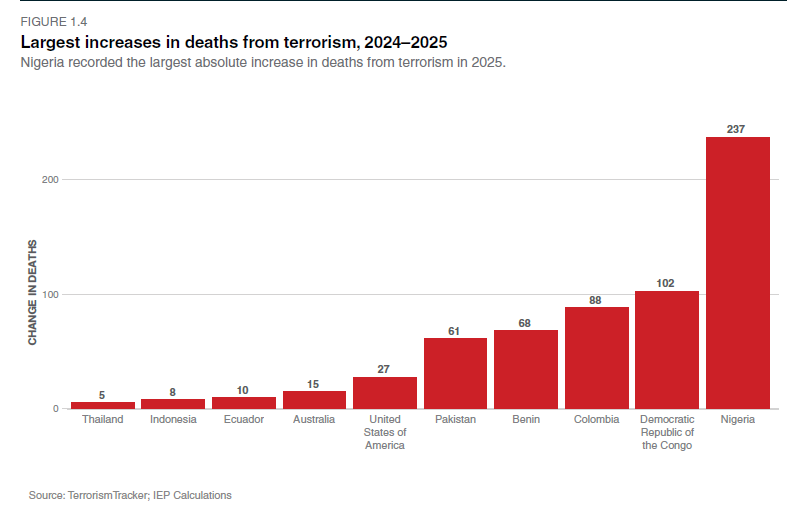
Nigeria recorded the largest increase in 2025, with fatalities rising by 46 per cent to 750, according to GTI 2026. Islamic State West Africa Province (ISWAP) and Boko Haram were responsible for 80 per cent of all terrorism deaths in the country. The Democratic Republic of the Congo (DRC) also recorded a significant increase in terrorism, reaching its worst ever position on the Index. Deaths in the DRC rose by nearly 28 per cent to 467, driven by attacks carried out by the IS-affiliated Allied Democratic Forces (ADF), according to GTI 2026. In keeping with ideology of the Islamic State, they targeted civilians, churches, hospitals, and funerals.
Middle East
Iran’s Islamic Revolutionary Guard Corp (IRGC), the intelligence service of Iran, is the key state sponsor of terrorism worldwide. IRGC sponsors criminals, militias and terrorist entities to conduct attacks. IRGC and its proxy Ansar Allah of the Houthi Movement in Yemen is supporting al Shabab, an Al Qaeda affiliate in Africa. With Al Qaeda leader Saif Al Adil locating to Iran, IRGC-Quds Force is building an alliance between Shi’ite and Sunni groups. Although the Islamic State has rejected rapprochement with Shi’ite groups, many Al Qaeda affiliates including Al Qaeda in the Arabian Peninsula has agreed to cooperate. Influenced more by politics and less by religion, Al Qaeda affiliates will work with Tehran. In the future, IRGC and its proxies are likely to support other Al Qaeda affiliates in Asia, Africa, and elsewhere worldwide.
Latin America
Terrorism deaths in Colombia increased by 70 per cent, and attacks rose by nearly 47 per cent, according to the GTI. The violence in Columbia is driven by dissident factions of the Revolutionary Armed Forces of Colombia (FARC) and the National Liberation Army (ELN), two groups that have revived. Like other threat groups worldwide, both FARC and ELN factions are using drones. They were inspired by conflicts in Ukraine, Gaza and now in the wider Middle East. According to GTI, FARC and ELN mounted 77 drone attacks between 2024 and 2025[4].
Response
With the outbreak of the War in the Middle East (February 28, 2026-…), the threat of extremism and terrorism will grow. To mitigate the threat at a global, regional, national and local level – leadership is vital. In addition to developing a whole-of-government and society approach to defeat terrorism, governments should advocate a shift from counter terrorism cooperation to collaboration and partnership.
Most governments are dealing with the threat in a fragmented way. The phenomenon of political violence and terrorism and their precursors extremism and exclusivism needs to be addressed comprehensively. Every government should develop a national counter terrorism and counter extremism policy and strategy where religious bodies, educational institutions and mass media are engaged. To address the threat, a robust and a far-reaching counter terrorism framework should be established. In addition to establishing a presidential/prime ministerial council of religious leaders, every religious cleric, teacher and media personality should be accredited. They should be mandated to promote moderation, toleration and coexistence.
Most countries have no national organisation mandated to fight terrorism. In parallel, there should be dedicated structures to prevent terrorism and rehabilitate terrorists. In addition to establishing a dedicated capability to counter threat finance, a dedicated digital intelligence capability should be established to monitor and respond to threats.
The International community should advocate a multi-agency, multi-dimensional, multi-national and a multi-jurisdictional response to fight terrorism. Counter terrorism laws are obsolete in most countries! There should be specialist courts to try terrorist suspects and prisons to house terrorists. There should be better coordination between the military forces, law enforcement authorities and national security agencies. There should be dedicated counter terrorism academies to train the government officers. Establishing common databases, exchange of personnel, joint training and operations, and, sharing of expertise and experience is vital! The basic building blocks of international cooperation are domestic and regional cooperation.
Prof. Rohan Gunaratna is editor of the “Handbook of Terrorism in the Asia-Pacific” (UK, Imperial College Press, 2016), “Handbook of Terrorism in the Middle East” (Singapore, World Scientific, 2022) and “Palgrave Handbook of Terrorism in Africa” (Cham, Switzerland, Palgrave Macmillan, 2025). At the S. Rajaratnam School of International Studies at the Nanyang Technological University in Singapore, he teaches intelligence and national security, and, homeland security, counter terrorism and intelligence. He trains military forces, law enforcement authorities and national security agencies.
[1] https://www.visionofhumanity.org/wp-content/uploads/2026/03/Global-Terrorism-Index-2026-Report.pdf
[2] https://www.visionofhumanity.org/wp-content/uploads/2026/03/Global-Terrorism-Index-2026-Report.pdf
[3] https://www.visionofhumanity.org/wp-content/uploads/2026/03/Global-Terrorism-Index-2026-Report.pdf
[4] https://www.visionofhumanity.org/wp-content/uploads/2026/03/Global-Terrorism-Index-2026-Report.pdf
A very profound update on the GTI 2026.
I find your point about ‘Madaris’ in Pakistan being nurseries for extremism particularly critical; it aligns with my own research into how religious texts are sometimes engineered to create a ‘silent launchpad’ for violence.
While security measures are vital, especially with the IRGC’s evolving alliances, we must prioritize the deconstruction of these inherited ideological frameworks at their educational roots.
This is the central theme of my analytical work, ‘ISIS IN THE SHADOW.’
Thank you, Professor, for highlighting the global epicenters of this threat.”