
By Rohan Gunaratna
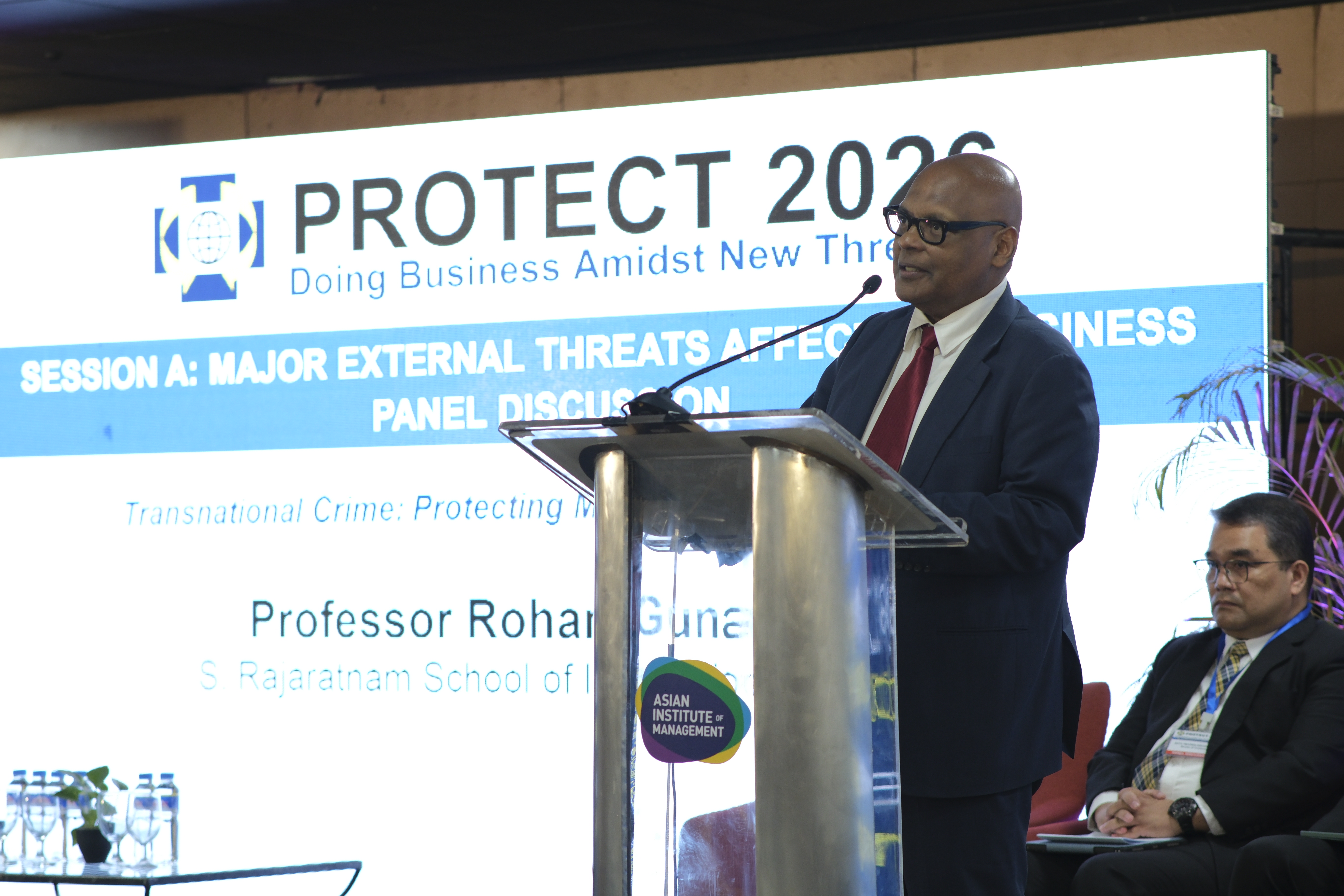
The following article is a reproduction of Prof Rohan Gunaratna’s address at The PROTECT2026 Conference held in Makati City, Philippines on the 14th of May 2026. The session was titled ‘Transnational Crime: Protecting Markets from Illicit Disruption’.
Introduction
What we are seeing today is no longer ordinary smuggling activity. The illicit tobacco trade has evolved into a highly organised transnational criminal enterprise involving sophisticated maritime networks, corruption systems, logistical coordination, and cross-border actors operating across Southeast Asia.
This article will examine how these networks operate, why they continue to thrive, and what strategic responses may be necessary to address the threat.
Cigarette smuggling in the Philippines has become increasingly organised, adaptive, and transnational in nature. The operations involve both maritime and land-based logistics systems connecting Mindanao, Palawan, the Visayas, and Luzon.
Smuggling syndicates exploit geographic vulnerabilities, especially remote coastlines, weak maritime monitoring, and fragmented enforcement environments. The major supply origins repeatedly identified include Sabah in Malaysia, Indonesia, the Sulu–Tawi-Tawi corridor, and the Zamboanga Peninsula.
What is particularly concerning is the sophistication of these criminal ecosystems. These groups rely not only on transport networks, but also on facilitators, corrupt protectors, local distributors, and concealment mechanisms that allow them to sustain operations even after seizures and arrests.
A strategic, security and governance challenge
At first glance, cigarette smuggling may appear to be only a customs or taxation issue. However, the reality is much broader and more serious.
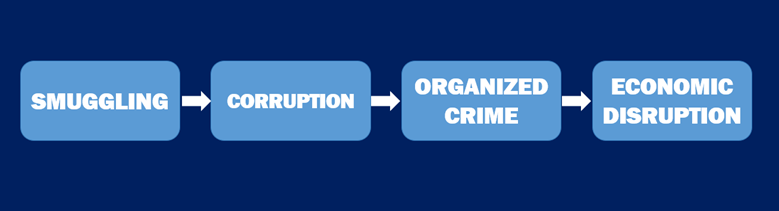
Illicit tobacco trade directly contributes to corruption, organized crime, and economic disruption. These smuggling activities weaken legitimate markets by avoiding taxes and undercutting legal businesses, while creating illicit revenue streams that strengthen criminal organisations and facilitate other illegal economies.
The repeated references to corruption and protection networks is because illicit trade can undermine governance and institutional credibility. Therefore, illicit tobacco smuggling should be viewed not simply as an economic problem, but as a strategic, security and governance challenge.
Smuggling hotspots
The intelligence reporting identifies several recurring smuggling hotspots and transit corridors, including Palawan, Tawi-Tawi, Sulu, the Zamboanga Peninsula, Sarangani, Davao Gulf, Negros Oriental, and Siquijor. The Sulu Sea corridor remains especially critical as it serves as a gateway between Malaysia, Indonesia, and the southern Philippines.
The smuggling routes follow a consistent operational pattern. Products originating from Malaysia or Indonesia are transported into Sulu and Tawi-Tawi, then redistributed toward Zamboanga, Palawan, and other areas in the Visayas and Luzon. After arriving at coastal landing points, the cigarettes are transferred into warehouses, hidden storage facilities, or secondary transport vehicles before being distributed through urban markets, sari-sari stores, and informal retail networks.
The syndicates demonstrate high operational adaptability, commonly using unmarked motorbancas, Jungkong-type vessels, and nighttime ship-to-shore transfers. Concealment tactics are sophisticated, with cigarettes hidden inside ice trucks, passenger vessels, vans, and mixed cargo shipments. They also employ evasion techniques such as fake documentation, segmented transportation, route diversification, and cargo abandonment when interdictions occur.
Emerging threat outlook
The illicit cigarette trade clearly reflects a transnational criminal structure operating across multiple jurisdictions, relying on local facilitators, transport operators, financiers, distributors, and alleged protection networks. What makes these systems resilient is their hybrid structure. They combine licit and illicit logistics, allowing criminal activity to blend into ordinary maritime commerce and community-level trade.
Looking ahead, the threat environment is expected to become even more complex, with criminal networks shifting toward decentralised maritime routes, smaller coastal landing areas, compartmentalised logistics, and increased use of digital communication. There is also growing convergence between cigarette smuggling and other illicit economies such as fuel smuggling, counterfeit products, and financial crime.
To address these challenges, several strategic responses are necessary. Maritime intelligence and surveillance capabilities must be strengthened. Corruption networks must be directly targeted. Interagency coordination and intelligence sharing must be improved through joint operational task forces. Technology and regional cooperation, particularly within ASEAN, will play an increasingly important role. Enforcement strategies should focus not only on seizures but also on financial disruption: following the money, seizing assets, and targeting laundering mechanisms.
In conclusion, the illicit cigarette trade in the Philippines demonstrates how transnational criminal networks exploit geography, corruption vulnerabilities, and enforcement gaps to disrupt legitimate markets. The issue extends far beyond smuggling itself, it affects governance, economic stability, public trust, and regional security.
Addressing this challenge will require intelligence-led enforcement, stronger regional cooperation, institutional resilience, and sustained anti-corruption efforts.
—
Rohan Gunaratna is a professor of Security Studies at the S. Rajaratnam School of International Studies at the Nanyang Technological University. He is a trainer for law enforcement, national security and military counter terrorism units; and is the author and editor of over 30 books.