
By Rohan Gunaratna
Introduction
To secure and advance US interests, the Trump Administration has developed three far reaching strategies – National Security Strategy, National Defense Strategy and Counter Terrorism Strategy. The US Counter Terrorism Strategy released by the White House in May 2026 highlights the renewed U.S. commitment to fight global terrorism. In his presidential foreword, President Donald J. Trump discussed his contribution after he returned to the White House on January 20, 2025.
Trump said, “As part of my commitment to defending America from all enemies, foreign and domestic, we are once again working to crush the threat of terrorism. Within 43 days, we apprehended the terrorist mastermind of the attack on Abbey Gate in Afghanistan that left 13 American service members dead.” Working with Pakistan, the US apprehended and extradited ISKP operator Mohammad Sharifullah for the murder of 170 Afghans and 13 Americans and injury of 150 Afghans and 45 U.S. troops in Abbey Gate, the entry point to the International Airport in Kabul on August 26, 2021.
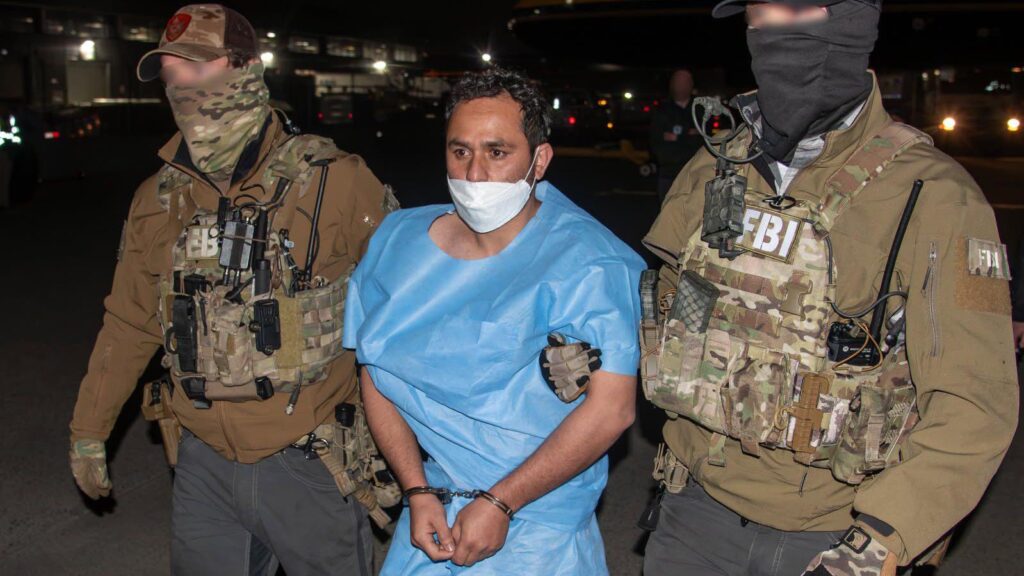
Demonstrating the long arm of the U.S., the CIA, FBI and other agencies worked together to capture Sharifullah. The Counter Terrorism Strategy 2026 is illustrated with a photo of Sharifullah escorted by FBI personnel.[1]
The Context
The Trump Administration targeted the top five Islamist groups that have the intent and capabilities to execute external operations against the U.S., starting with “al Qaeda – especially its most aggressive subgroup, al Qaeda in the Arabian Peninsula (AQAP) – and ISIS, starting with ISIS-Khorasan (ISIS-K).”
As the Muslim Brotherhood (MB) provided the foundational ideology of Al Qaeda and the Islamic State, the Trump administration also designated MB’s key chapters as “terrorist groups”. In addition to removing Jihadist sympathizers, the Trump administration designated transnational criminal entities as terrorist organisations. The U.S. played a pivotal role in ending the Gaza war and secured the release of hostages, and is implementing a plan to secure Gaza through the Board of Peace.
The Middle East War is a consequence of the Hamas-led attack on Israel. Hamas is one of the threat groups sponsored by the Iranian regime. In addition to developing a military nuclear program, Iran’s Islamic Revolutionary Guard Corps (IRGC) developed ballistic and cruise missile and proxy capabilities to stage attacks. The U.S. launched Operation Midnight Hammer in 2025 and Operation Epic Fury in 2026 according to the U.S. Counter Terrorism Strategy, targeting “the world’s number one state sponsor of terror, the sinister regime in Iran, to ensure they can never have a nuclear weapon.”
The Focus on Asia
The U.S. Counter Terrorism Strategy Report stated, “Asia includes the most populous Muslim nations and, as a region, is central in the spread of Islamist ideology, the recruiting of terrorists, and the raising of funds for attacks against the homeland and maritime trade routes vital to the United States and our partners, including Japan, South Korea, and Australia. As recent attacks and disrupted terror plots inside America make clear, the South and Central Asian diaspora populations here, along with our Arab populations, are being targeted for radicalization by these terror groups. As a result, the United States and regional partners must jointly develop effective counter-propaganda means to identify and neutralize the media platforms of terrorist groups and identify and locate plotters before they can kill Americans. The United States is open to new partnerships in Asia where shared CT interests are identified.”
The report adds, “In 2025, President Trump rebuilt critical relationships with partners in South and Central Asia because these relationships are crucial to reducing the terrorist threat to the homeland. But our European partners must increase their CT operations in Asia, as in Africa and the Middle East. We will work with them, but will not bear the brunt of the burden to protect wealthy nations who should be able to act as mature counterterrorism actors. Al Qaeda and ISIS still operate across numerous countries in Asia, exploiting ungoverned space to establish safe-havens, or in the case of Iran, are being directly sheltered by inimical regimes outside Asia. It is not cost-effective, wise, or even possible for the United States to continue to conduct CT activities everywhere, all at once, and in a vacuum. Peace can only be achieved through strength, therefore we will further burdenshare and burdenshift CT efforts to countries in South and Central Asia.”
The Future
Trump’s unequivocal message is “Our new U.S. Counterterrorism Strategy is a return to common sense and Peace through Strength. As I said after our first successful counterterrorism mission, just days after I was sworn back in office – if you hurt Americans, or are planning to hurt Americans, ‘We Will Find You and We Will Kill You’’.”
With the global rise of exclusivism, extremism, violence and terrorism, it is imperative for governments worldwide to assess the current and emerging threat and develop strategies to fight the threat both at home and overseas. Without competing with each other, the west and the east should partner, collaborate and cooperate to dismantle threat entities largely located in the global south.
—
Rohan Gunaratna is a professor of Security Studies at the S. Rajaratnam School of International Studies at the Nanyang Technological University. He is a trainer for law enforcement, national security and military counter terrorism units; and is the author and editor of over 30 books.
[1] https://www.whitehouse.gov/wp-content/uploads/2026/05/2026-USCT-Strategy-1.pdf
Presents a very insightful and comprehensive analysis of the US CT strategy 2026.