
By Rohan Gunaratna
Introduction
To meet the realities of modern maritime conflict and to defend its interests throughout the globe, the Trump Administration unveiled its plans to build the most capable and advanced Fleet. The Golden Fleet is US Navy’s bold investment to revitalize America’s maritime industrial base, rapidly building and sustaining the Fleet. To bring back American maritime industrial might, John C. Phelan, Secretary of the Navy. “Now when a conflict arises, you’re going to ask us two questions: where is the carrier, and where is the battleship.”[1]
“As we forge the future of our Navy’s Fleet, we need a larger surface combatant and the Trump class Battleships meet that requirement,” said Adm. Daryl Caudle, 34th Chief of Naval Operations. “We will ensure continuous improvement, intellectually honest assessments about the requirement to effectively deter and win in the 2030s and beyond, and disciplined execution resulting in a Fleet unparalleled in lethality, adaptability and strength.”[2]
The Context
The rapid expansion of China’s naval fleet prompted the US to boost its naval capabilities. The People’s Liberation Army Navy (PLAN) is the world’s largest navy by number of ships, including aircraft carriers, destroyers, frigates, and submarines, rapidly expanding with modern, home-built ships, though the U.S. Navy still leads in overall tonnage and large carriers, while China focuses on building its surface fleet with impressive shipbuilding capacity and increasing firepower. The largest fleet by number, PLAN has over 370 ships and submarines, surpassing the U.S. by sheer vessel count. About 70% of China’s warships were launched after 2010, featuring advanced destroyers, frigates, and corvettes.
China’s shipyards produce warships at an unmatched pace, significantly boosting its naval power. It also operates three aircraft carriers (Liaoning, Shandong, Fujian) and plans for more. The increasing numbers of Vertical Launch System (VLS) cells for missiles, is adding significant firepower. In response to China’s massive, modernizing fleet, rapidly closing the qualitative gap with the U.S. by building more ships, faster than any other nation, the Trump Administration has engaged the U.S. industrial complex.
To counter China’s rise, the Trump administration will revamp the U.S. Navy by building the largest surface combatant since World War II. The U.S. Navy will buy two new “battleships” as part of the “Golden Fleet” effort, President Donald Trump, Defense Secretary Pete Hegseth and Navy Secretary John Phelan announced on December 22, 2025. The U.S. Navy will purchase two ships and eventually purchase 10, with a goal of 20 to 25 in total for the class with the start of construction planned for 2030.
Images of a future USS Defiant (BBG-1) were featured alongside Trump, Hegseth and Phelan, as well as a ship logo based on the July 13, 2024, Evan Vucci photo taken shortly after Trump was shot in the ear during an assassination attempt amid his presidential campaign.
“The future Trump-class battleship – the USS Defiant – will be the largest, deadliest and most versatile and best-looking warship anywhere on the world’s oceans,” Phelan said during the presentation. “Now there will be work for shipyards everywhere from Philadelphia to San Diego, from Maine to Mississippi, from the Great Lakes to the Gulf Coast, and for manufacturers that will build components for this battleship in every state.”
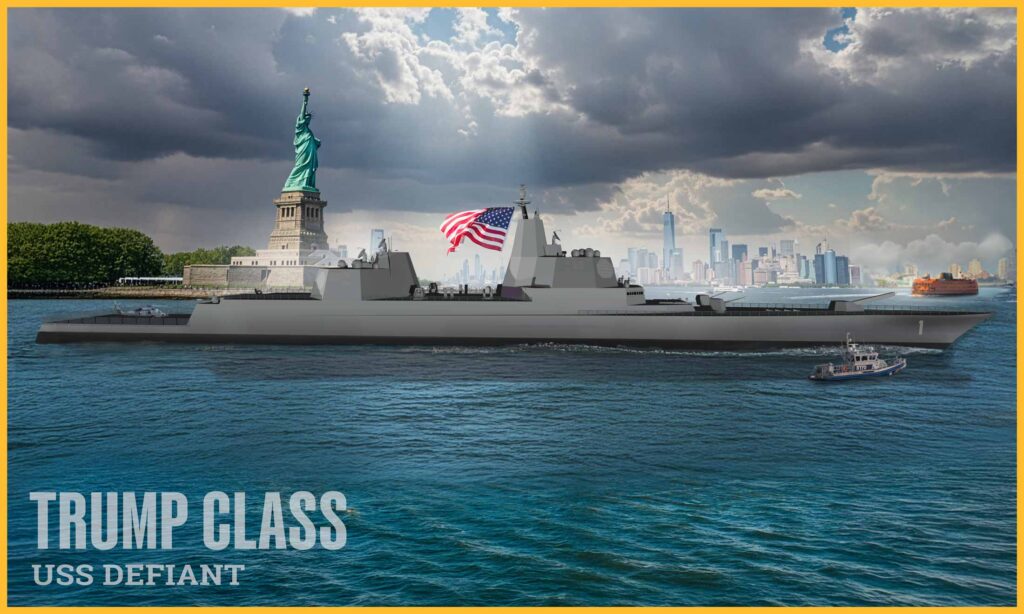
The US Navy’s new platform the 35,000-ton warship and draft 24 to 30 feet will be more than double the size of the 15,000-ton Zumwalt class of destroyers, which is the largest surface combatant currently in the fleet. The steel ships will be built in the U.S. with other countries.
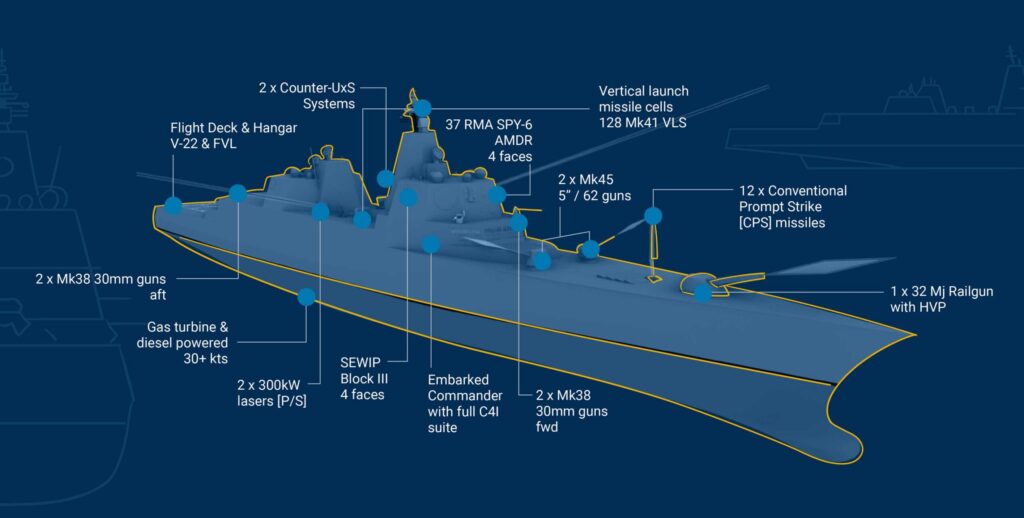
Although Trump said: “It’s a counter to everybody. It’s not China”, China’s PLAN is building a gigantic navy. The U.S. ships will replace the Navy’s next-generation DDG(X) program, which was projected to be about half the size of this proposed battleship. Construction is slated to begin in the early 2030s with the Navy serving as the lead design agent for the effort. The Navy first unveiled the DDG(X) concept in 2022. Like the DDG(X) program, the new ships will feature existing combat systems and weapons in use on the Flight III Arleigh Burke DDG-51 guided-missile destroyers. They will field the AN/SPY-6 air search radar, 128 MK-41 vertical launch system cells, 12 Conventional Prompt Strike long-range hypersonic missiles and five-inch guns. The design will also leave margin to add additional weapons, including directed energy, the nuclear-armed sea-launched cruise missile and potentially a 32 Megajoule rail gun. Like the initial DDG(X) concept, Defiant would use gas turbines and diesels to drive an electrical grid that would supply power to the ship’s weapon systems and sensors. The ship would be capable of speeds in excess of 30 knots. The flight deck and hangar will be capable of fielding V-22 Osprey tilt-rotors and the next future vertical lift aircraft. “The battleship will be capable of operating independently, as part of a Carrier Strike Group, or commanding its own Surface Action Group depending on the mission and threat environment…. With the ability to provide forward command and control for both manned and unmanned platforms, [the] battleship will be a critical component in executing the Navy Warfighting Concept.”[3]
Background
Trump administration’s overhauling of the Navy’s acquisition plans is spearheaded by Phelan and Chief of Naval Operations Adm. Daryl Caudle. The U.S. Navy would buy a patrol frigate based on the U.S. Coast Guard’s Legend-class National Security Cutter program built by HII’s Ingalls Shipbuilding. Phelan’s truncation of the Constellation-class frigate line in November 2025 after the program faced ongoing delays due to design and workforce challenges. The US Navy explored multiple size options, including up to 50,000 tons, before settling on a 30,000-ton battleship. Other options included a smaller ship that could have been 15,000 to 20,000 tons. Naval analyst Bryan Clark told USNI News earlier December 2025 that the Navy is considering buying 12 to 13 vessels in this new ship class that could field large hypersonic missiles in large specialized missile tubes in addition to the traditional MK-41 VLS cells. The three Zumwalt-class destroyers are currently having Conventional Prompt Strike tubes installed at HII’s Ingalls Shipbuilding in Pascagoula, Miss. The cost of building this battleship in an American yard could range from $10 to $15 billion, based on the size and the systems that are included.
The Navy previously worked with HII’s Ingalls Shipbuilding in Pascagoula, Miss., and General Dynamics Bath Iron Works in Bath, Maine, which have both built surface combatants. Both yards said they are standing by to support the Navy’s new effort.
“General Dynamics Bath Iron Works stands ready to fully support the Navy in the design and construction of this important new shipbuilding program,” Charles Krugh, the president of Bath Iron Works.
HII CEO Chris Kastner said in a statement to USNI News: “We understand the urgency and have taken a number of actions to increase the speed at which we can deliver. We have seen improvements in our labor and throughput and expect these to continue in 2026. These efforts combined with our distributed shipbuilding network are working, and more capacity is being created to meet these critical requirements.”[4]
Asked how the U.S. would ensure it has a sufficient workforce to build the new ships, Trump said shipyards would utilize robots.[5]
The U.S. industrial base has not delivered a battleship to the Navy since 1944, when the 60,000-ton USS Missouri (BB-63) was turned over to the Navy. Missouri was later the site of Japan’s formal declaration of surrender at the end of World War II. The nuclear cruiser USS Long Beach (CGN-9), which was in service from 1961 to 1995, was 17,000 tons fully loaded.
In the current fleet, the Zumwalt class at 15,000 tons is the largest surface combatant. The Navy proposed building a 20,000-ton guided-missile cruiser – the CG(X) – but the Obama administration cancelled the program in 2010 due to cost and schedule reasons. Instead, the Navy elected to build the Flight III Arleigh Burkes.
Over the years the Navy has struggled to move forward with its DDG(X) program, a planned follow-on to the Arleigh Burke-class guided-missile destroyer. Planned purchase and construction timelines for DDG(X) were delayed several times as the Navy racked up bills for current ship classes and the development of new programs like the next-generation attack submarine and the sixth-generation fighter.
The Future:
China’s Advantages & Growing Strength:
Sheer Numbers: China surpassed the U.S. in total ship count around 2020 and continues rapid expansion, projecting a fleet of over 400 ships by 2030.
Blue-Water Navy: The PLAN has transitioned from coastal defense to projecting power globally, with new carriers and amphibious ships.
Anti-Ship Missiles: China fields “carrier killer” missiles (DF-21D, DF-26) that threaten U.S. carriers from afar.
Closing Capability Gaps: China’s advanced destroyers (Type 055) and increasing VLS cells are rapidly narrowing the technological gap with the U.S..
U.S. Advantages & Challenges:
Technology & Experience: The U.S. Navy still leads in technology, carrier operations, and combat experience, though this advantage is eroding.
Submarine Fleet: The U.S. maintains a significant, though shrinking, edge in its nuclear-powered attack submarine (SSN) force.
Fleet Size Decline: The U.S. shipbuilding rate struggles to keep pace with losses and Chinese growth, leading to fewer ships.
Potential Conflict Dynamics:
Regional Focus: China’s strength is most potent in its “near seas” (Western Pacific), leveraging its shore-based missile defenses.
Asymmetric Warfare: China relies on anti-ship missiles and electronic warfare to counter U.S. carrier groups.
Technology vs. Quantity: A conflict would test whether U.S. technological superiority and alliances can overcome China’s overwhelming numbers and missile threat.
In essence, while China boasts a larger fleet and rapidly improving tech, the outcome of a hypothetical war remains uncertain, with experts pointing to China’s growing confidence in challenging U.S. dominance in the Pacific.
Conclusion
While China’s People’s Liberation Army Navy (PLAN) now has more ships than the U.S. Navy, a direct fight is complex. China excels in quantity, closing the Vertical Launch System (VLS) gap, and possesses potent anti-ship missiles, but the U.S. retains technological advantages, experience, and a formidable submarine force, meaning victory depends heavily on the scenario, location, and integration of technology, though China’s rapid growth is shifting the balance, especially in the Pacific.
With the latest U.S. plan, Washington has challenged China’s advantages and growing strength in terms of sheer numbers. China surpassed the U.S. in total ship count around 2020 and continues rapid expansion, projecting a fleet of over 400 ships by 2030. The PLAN has transitioned from coastal defense to projecting power globally, with new carriers and amphibious ships in the blue water navy. China fields “carrier killer” missiles (DF-21D, DF-26) and other anti-ship missiles that threaten U.S. carriers from afar. Both the US and China are closing their capability gaps. China’s advanced destroyers (Type 055) and increasing VLS cells are rapidly narrowing the technological gap with the U.S. The
U.S. advantages and knowledge gaps are being closely studied by China. Nonetheless, the U.S. Navy still leads in technology, carrier operations, and combat experience, though this advantage is eroding. The U.S. maintains a significant, though shrinking, edge in its nuclear-powered attack submarine (SSN) force. Until recently, the U.S. shipbuilding rate struggles to keep pace with losses and Chinese growth, leading to fewer ships.
China’s strength is most potent in its “near seas” (Western Pacific), leveraging its shore-based missile defenses.
China relies on anti-ship missiles and electronic warfare to counter U.S. carrier groups.
As for technology vs. quantity, a conflict would test whether U.S. technological superiority and alliances can overcome China’s overwhelming numbers and missile threat.
In essence, while China boasts a larger fleet and rapidly improving tech, the outcome of a hypothetical war remains uncertain, with experts pointing to China’s growing confidence in challenging U.S. dominance in the Pacific.
—
Professor Rohan Gunaratna teaches national security and intelligence and homeland security and counter terrorism at the S. Rajaratnam School of International Studies, Nanyang Technological University in Singapore. He is the author and editor of 30 books.
[1] https://www.navy.mil/Press-Office/Press-Releases/display-pressreleases/Article/4366856/president-trump-announces-new-battleship
[2] https://www.navy.mil/Press-Office/Press-Releases/display-pressreleases/Article/4366856/president-trump-announces-new-battleship
[3] Mallory Shelbourne and Sam Lagrone, “Trump Unveils New Battleship Class; Proposed USS Defiant Will Be Largest U.S. Surface Combatant Since WWII,” USNI, December 22, 2025 https://news.usni.org/2025/12/22/trump-unveils-new-battleship-class-proposed-uss-defiant-will-be-largest-u-s-surface-combatant-since-wwii
[4] Mallory Shelbourne and Sam Lagrone, “Trump Unveils New Battleship Class; Proposed USS Defiant Will Be Largest U.S. Surface Combatant Since WWII,” USNI, December 22, 2025 https://news.usni.org/2025/12/22/trump-unveils-new-battleship-class-proposed-uss-defiant-will-be-largest-u-s-surface-combatant-since-wwii
[5] Mallory Shelbourne and Sam Lagrone, “Trump Unveils New Battleship Class; Proposed USS Defiant Will Be Largest U.S. Surface Combatant Since WWII,” USNI, December 22, 2025 https://news.usni.org/2025/12/22/trump-unveils-new-battleship-class-proposed-uss-defiant-will-be-largest-u-s-surface-combatant-since-wwii